2025: Adding Meaning to Measurement
BY
Unathi Lutshaba
10.12.25
As 2025 draws to a close, I find myself reflecting on a year that not only celebrated a decade of the South African Cultural Observatory’s existence, but also one that redefined what our next ten years will stand for.
For much of our first decade, SACO’s work focused on measurement — counting, mapping, and building the evidence base that finally proved the scale and contribution of South Africa’s cultural, creative, and (more recently) sports economies.
In 2025, we began something new: adding meaning to measurement.
This shift – from data to direction, from statistics to strategy – has been powered by three key elements, a kind of 3 Ps: people and partnerships, research products, and platforms. This approach builds on the legacy of our previous decade of work.
And so this month as we think of well deserved breaks (and remember the creatives and sportspeople don’t stop over the festive, so support them), I wanted to reflect on how meaning is becoming the centre of our universe, through these elements.
I must start with platforms – because we built an incredible one: #SACOConf2025.
Platforms that mean something
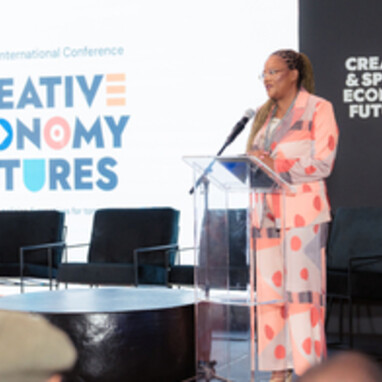
Our 5th International South African Cultural Observatory Conference, held at the DHL Stadium in Cape Town, was the year’s defining moment and itself a defining platform for a new type of discussion. Under the theme “Creative and Sports Economy Futures: Fresh Perspectives, Policies and Practices,” we gathered more than 400 delegates to reflect on the journey so far – and to chart the decade ahead.
The message that echoed through every discussion was clear: measurement alone is no longer enough. We need meaning. To unlock South Africa’s creative and sports potential, we must translate evidence into equity – building systems that make our data work for creators, sportspeople, and policymakers alike.
Through the conference, we demonstrated what that could, and does, look like: data connecting with debate; evidence meeting lived experience; and research sparking innovation.
This platform, and a few others we have produced in the last 24 months (such as Cafe AI and our AI report, and our creative First Thursdays programme on the ground in Gqebhera) are an example of creating a space where SACO evidence can reach and teach in new ways.
Building global partnerships, strengthening local impact through people
This year we really deepened SACO’s international engagement and partnerships; and expanded our work with incredible people and local partners.
On the global front some highlights bare remembering:
- In Paris, we participated in the UNESCO Art for All meeting, where we joined global peers to discuss inclusive creative policy frameworks. The trip strengthened SACO’s collaboration with UNESCO and UNCTAD, setting the stage for a more delivery-orientated international research agenda in 2026 – one that builds on the strong foundations laid with Culture Solutions through the Africa–Europe Foundation (AEF) project.
- In Turin, with the British Council and UNCTAD, we participated in the Creative Economy Foresight Training hosted by the International Training Centre of the International Labour Organization (ITCILO). This was not just a learning exchange – it was an investment in our collective future capacity to anticipate change and prepare creative workers for the next economy.
- At the Russia Creative Industries Summit (RICS), we shared South Africa’s model for mapping and analysing the creative sector, offering best practices from our national approach while learning from our BRICS partners. This exchange has laid the groundwork for a potential Memorandum of Understanding – currently under review at Nelson Mandela University – that could expand our collaborative research and benchmarking in 2026.
On the local front, some highlights:
- In April, we participated in the Creative Cnergy Symposium, a symposium that reminds us, not only of the power of gathering, but of our collective capacity to shape the future. We joined the industry discussions in exploring the Economic Potential of South Africa’s Creative Industries.” A question we at the South African Cultural Observatory, or SACO, have been tackling with determination for almost a decade now. And so, we pushed that question a little further and started asking: “What is the future of the creative economy in an increasingly uncertain world? And more importantly — how do we prepare for it?”
- We also participated in the AI & Immersive Futures Convening, driven by Electric South - a platform that brings African-centred perspectives into AI discourse, advocating for African creatives to have agency in: the tools they use, the narratives they create and the governance systems that affect their work.
- We were also invited by the Department of Communications and Digital Technologies to Chair the Subcommittee on Research and Data Collection – Advisory Committee on Gaming, Animation and Filmmaking. The purpose of this work is to coordinate national efforts to grow the digital creative industries through inclusive partnerships and evidence-based decision-making.
Each of these moments reminded us that the South African creative economy does not exist in isolation. It is part of a global conversation – and SACO’s role is to ensure that African perspectives help lead it.
Locally, we are building on our existing partnerships but also expanding them. A big win this year has been more collaboration with the private sector, much of which culminated at the #SACOConf2025. Watch out for some announcements on media partnerships – coming soon.
Turning data products into design
At home, 2025 also marked a year of deepening our research output and institutional resilience.
We received our first ever research grant, awarded by the Africa–Europe Foundation for two reports on cultural cooperation and its impact on the youth, delivered with our partner, culture Solutions Europe. The grant supports our work on youth skills development in the cultural and creative economy, expanding our international research collaboration and positioning SACO as a thought leader in evidence-based cultural policy for the continent. It also puts us in the futures and foresight game.
Our Creative and Sports Economy Mapping Study continued to track the sector’s economic contribution – estimated at R271 billion and 1.4 million jobs between 2021 and 2023 – while new dissemination initiatives, added to our regular workshops, have made our data more accessible to decision-makers, researchers, and practitioners.
We strengthened our digital platforms and communications ecosystem, ensuring SACO’s research, data, and insights reach the people who need them most – from community organisers and entrepreneurs to policymakers and educators.
Back to the future
The year ahead will build on this momentum. In 2026, SACO will focus on three strategic priorities:
- Expanding research collaboration and foresight capacity through international partnerships, grants, and training;
- Embedding evidence into policy and practice, ensuring our data continues to inform decisions at all levels of government; and
- Investing in platforms and people: strengthening the Observatory’s infrastructure and supporting the next generation of creative-economy researchers.
As we enter our second decade, I am deeply proud of how SACO has evolved from a data repository into a living observatory, an organism – one that measures, connects, and inspires.
The creative and sports economies remain two of South Africa’s greatest sources of innovation and identity. Our task is to ensure they are also engines of inclusion, economic growth and sustainability.
To our partners, colleagues, and friends, in South Africa and around the world, thank you for your continued collaboration, trust, and belief in our mission.
Here’s to another year of building more meaning to the measurement we’re all committed to, together.
Warm regards,
Unathi Lutshaba
Executive Director
South African Cultural Observatory