
Cultural, Creative and Sports Industries contribute nearly 4% to South Africa’s GDP, report shows
Nowcasts signal continued resilience for CCI&S amid global uncertainty
Johannesburg | 16 February 2026: South Africa’s Cultural, Creative and Sports Industries (CCI&S) contributed an estimated R271.2 billion to national GDP in 2023, accounting for approximately 3.9% of total GDP, according to the South African Cultural Observatory (SACO).
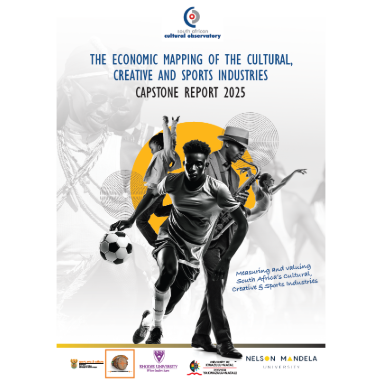
The Capstone Report 2025: Measuring and Valuing South Africa’s Cultural, Creative and Sports Industries will be discussed at a strategic forum this week, situating this data within current global and national policy contexts – including the tectonic shifts caused by artificial intelligence and its implications for content generation in particular, but also cross-society disruptions and techno-geopolitical conflict.
The report, commissioned by the Department of Sport, Arts and Culture and conducted by the South African Cultural Observatory, a project of the department hosted by Nelson Mandela University, provides an update on a decade-long stream of bi-annual economic data on the creative and cultural industries emerging from the SACO.
The latest report includes sports data for the first time, enabling a comprehensive view of the sectors within the Department’s mandate. This delivers the most complete economic mapping of the sector to date, based on official Statistics South Africa datasets and internationally recognised accounting standards.
“For ten years, we have been quietly counting and classifying, tracking the pulse of South Africa’s cultural, creative, and, more recently, sports economy. What we see is an ecosystem that is not just cultural or creative, but deeply competitive,” said SACO Executive Director, Unathi Lutshaba.
Between 2021 and 2023, the creative and cultural industries and sport (CCI&S) recorded steady growth, with total GDP contribution increasing from R250.7 billion in 2021 to R271.2 billion in 2023, reflecting a sustained post-pandemic recovery and increased activity across multiple cultural domains.
On average, the combined CCI&S accounted for around 3.9% of South Africa’s GDP between 2021 and 2023, a contribution comparable in scale to several established sectors such as agriculture and construction.
The report finds that the sector’s economic impact extends well beyond direct production. Indirect and induced effects account for approximately two-thirds of total GDP contribution, highlighting the sector’s extensive value chains and its role in supporting broader economic activity. Of the total impact, 36% is generated through direct production, while around 26% is induced through labour income and associated household spending.
Cultural and creative industries remain the largest contributor within the combined sector, increasing from R199.0 billion in 2021 to R211.2 billion in 2023. The sports industry, while smaller in absolute terms, showed faster proportional growth, rising from R51.7 billion to R60.0 billion over the same period, with year-on-year growth rates of 4.4% and 11.1%, respectively.
The economic estimates are derived from Statistics South Africa’s Annual Financial Statistics, Quarterly Labour Force Survey, Labour Market Dynamics Survey, Supply and Use Tables, and the Social Accounting Matrix, and are constructed using the 2008 System of National Accounts and the UNESCO Framework for Cultural Statistics (2009). This ensures international comparability and methodological consistency.
While the GDP estimates are reported up to 2023, the latest year for which complete official datasets were available at the time of compilation, this report emphasises a standard characteristic of national accounts-based analysis rather than an indication of sector stagnation.
According to the report, the findings provide a robust statistical foundation for policy development, investment planning, and sector support, particularly as digitisation and platform-based distribution continue to reshape cultural and creative production.
Report lead author Tefelo Majoro, emphasised the “high-octane” potential of the industries, if more investment could be made.
“The numbers are promising and stable. Together, the cultural, creative and sports sectors represent a major and resilient contributor to South Africa’s economy. This strength has been sustained over the last decade – even in times of great stress and upheaval, such as the COVID-19 pandemic. With the right strategic levers, even further growth could be unlocked,” she said.
While the latest complete national accounts data run to 2023, early labour market and production indicators suggest continued activity and resilience across several CCI&S domains. Although global growth projections for 2026 remain constrained amid geopolitical and technological shifts, the sector’s recent trendline indicates it is broadly aligned with national economic performance, with pockets of strength in digital and services-oriented activities.
Employment, sector make-up
The CCI&S employ 1.4 million South Africans – from filmmakers and festival organisers to designers, athletes, coaches, and content creators. The report shows this is a youthful, dynamic workforce. The majority of those employed are between 25 and 39 years old.
The sectors employ a higher share of women and young people than almost any other sector in the country and represent one of South Africa’s most inclusive labour markets, but transformation remains unfinished business.
While Black workers make up three-quarters of employment in the sector, ownership and leadership are still unequally distributed. And although women represent nearly half the workforce, the gender pay and authority gap persists.
“The data doesn’t just measure progress; it tells us where inclusion still needs to deepen. It reminds us that numbers are not neutral, they are stories about people, opportunity, and access,” added Lutshaba.
Global trends, local impact
Last month the World Economic Forum's (WEF) Global Risks Report 2026 identified the world is entering an “age of competition” marked by fragmentation, geopolitical, and geoeconomic confrontation. Half of the surveyed experts expect a “turbulent" or “stormy” outlook over the next two years, with 57% predicting this long-term.
The strategic forum to discuss the 2025 SACO report aims to contextualise the findings within a decade of research by the Observatory, and “the storm”. The goal is to use the data and a decade-long trendline from SACO research, to overlay it on future scenarios and discuss what the next 10 years may bring amid the rise of AI, and its direct impact on content generation and creativity, as well as the role of other frontier technologies.
“Technology is evolving faster than our policy cycles can adapt. AI, automation and digital platforms are transforming creative work at an exponential pace. The very definitions of creativity, authorship and value are being rewritten – and with that we need to use our data and collective power to ensure we are not written out,” said Cynthia Khumalo, DSAC Director-General.
The forum brings together key players in the CCI&S to look backward at the trendline and forward towards a vastly different future where, ideally, says Lutshaba, there is a story of exponential growth – enabled by AI – not of erosion.
Key Figures: South Africa's Cultural, Creative & Sports Industries 2024
Economic Impact
GDP Contribution
-
- R271 billion total contribution to GDP
- 4% of South Africa's GDP
- Growth from R250.7 billion (2021) to R271.2 billion (2023)
Employment
-
- 4 million jobs created
- 2% of total national employment
- 35% growth in employment from 2021 to 2024
Income & Poverty Alleviation
Household Income
-
- R244 billion total income to households
- R45 billion directed to lower-income households
- Income to low-income households grew from R40.8 billion (2021) to R45.9 billion (2023)
Government Revenue
-
- R117 billion in tax revenue generated
International Trade
-
- US$304 million in cultural goods exports
- US$239 million in cultural goods imports
- US$64 million trade surplus
- 60% of exports go to USMCA region (US, Mexico, Canada)
Demographics
Gender Distribution
-
- Male: 750,696 (52%)
- Female: 678,366 (48%)
Employment Race Distribution
-
- African/Black: 75%
- White: 14%
- Coloured: 8%
- Indian/Asian: 4%
Age Profile
-
- Largest employment: 20-34 age group (youth-dominated sector)
Geographic Distribution
Provincial GDP Share
-
- Gauteng: 41.7%
- Western Cape: 15.7%
- KwaZulu-Natal: 16.9%
- Top 3 provinces account for over 70% of national CCI&S GDP
Top Performing Domains
By GDP Contribution:
- Audiovisual & Interactive Media: 20%
- Design & Creative Services: 20%
- Sports & Recreation: 22%
By Employment:
- Sports & Recreation: 22.1%
- Design & Creative Services: 20.2%
- Audio-Visual & Interactive Media: 19.8%
For more information contact:
Titus Chuene, SACO Marketing Manager
About the South African Cultural Observatory (SACO)
The South African Cultural Observatory (SACO) is the StatsSA of the cultural and sport economy. It acts as a national research centre dedicated to the development of a comprehensive cultural information system for South Africa. Conceived of in 2013, through the Mzansi Golden Economy (2011) strategy, and then Department of Art and Culture, the SACO is a project of the South African Department of Sport, Arts and Culture (DSAC) hosted by the Nelson Mandela University in partnership with the University of KwaZulu-Natal, and Rhodes University.
The SACO was officially established in 2015 to develop a more sophisticated understanding of South Africa’s cultural and creative economy – and also to map trends, develop statistics, gather economic data across the arts, culture and heritage sectors and the cultural and creative industries (CCIs); and to inform decision and policymakers. Since then, it has been fundamental in shaping new knowledge, tools, and insights into South Africa’s cultural and creative economy.
In 2019, DSAC incorporated sports into its ambit of policy making and government support. Under ots new 5-year contract term with DSAC, from 2023, the now also focuses on mapping the economic impact of sports in South Africa.
About the Department of Sport, Arts and Culture (DSAC)
The DSAC is a governmental department in South Africa responsible for the promotion, development, and preservation of sport, arts, and culture in the country. Its mandate includes fostering social cohesion, nation-building, economic growth, and sustainable development through various initiatives, policies, and partnerships.
About Nelson Mandela University
Nelson Mandela University, located in Gqeberha, South Africa, is committed to academic excellence, innovative teaching, and community engagement. The university is renowned for its focus on social and environmental sustainability and its contributions to the development of the Eastern Cape region and the nation.