
Note from the Culturalist: CEO
SOUTH AFRICA’s cultural and other heritage capital is significant and mostly beyond a value measure. Where we can attach monetary or other value – and we definitely should – are the places where transactions can be measured: sales, encounters, business growth, and entrepreneurialism.
These spaces largely occupy the "related domains" - tourism, sports & recreation, audio-visual and interactive media and design and creative services sphere - and not many of the pure cultural domains, if one views the creative economy through the lens of UNESCO’s Framework for Cultural Statistics [diagram below]. That said, the linkages and interrelations are patently clear – and therein lies the opportunity.

The depth of South Africa’s diversity, contrast, collision and collaboration is something that can be leveraged on a grander scale. It’s also something that needs to be done to turnaround economic growth – and part of the job we are tasked with doing is trying to quantify the value of such intangible things as arts, heritage and culture to unlock their potential.
One of the most obvious routes to, or first steps in, unlocking such potential arises via tourism – domestic and international. The latest Tourism Satellite Account for South Africa report notes that tourism in 2014, tourism contributed 3,0% to the South African economy, higher than agriculture (2,5%) but smaller than all other industries. Tourism’s contribution of 3% is only slightly smaller than the 3,1% recorded for 2005.
By contrast, Mauritius derives about 25% of its GDP from tourism. It is but a small imaginative exercise to think up a moment in which tourism contributes to about 10% of our GDP. In fact it’s achievable, especially if we anchor it firmly to the immense creative talent and wealth in the still untapped arts, heritage and culture sectors.
This thinking around GDP, growth and creativity is in sharp focus as we scramble to find the funds to support the higher education of students – how do we turn it on? In a way, the students themselves are fighting for their future inheritance, heritages they will leave – and also against a heritage many challenge – colonialism, apartheid – all of which have been protested drawing on symbolic icons from the arts, heritage and culture sectors.
We certainly live in interesting times that challenge us to do better with what we have so we can thrive. I firmly believe that the arts, heritage and cultural sectors help us cope with, contest and adapt to changes. They healthier these sectors are – the healthier we are as a country - and arguably, the better the economy does.
SACO Activities
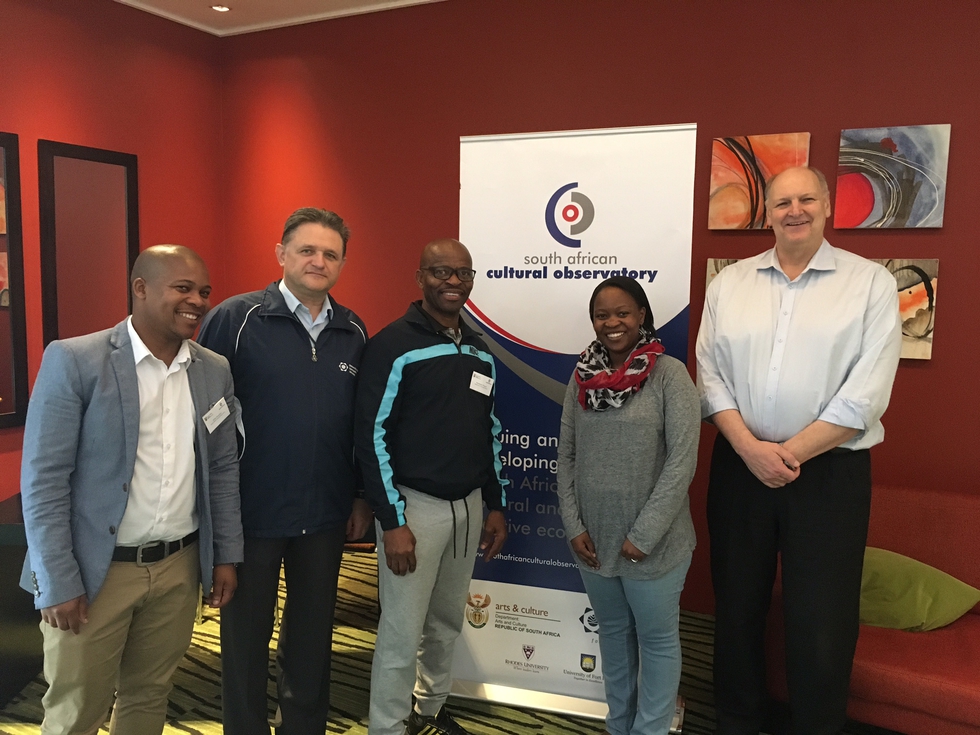
It’s been a busy September again with domain workshops and capacity building workshops occupying most of our energy. The outcomes so far are telling – both of a need for such workshops, and also of the value of reaching into the lesser serviced centres across South Africa. We have completed workshops – and struck up lasting relationships with creative practioners, academics and arts administrators in Limpopo, North West, the Northern Cape, and in Rustenburg. We have also hosted two capacaity building workshops with DAC municipal and government employees working in the sector on statistical frameworks and monitoring and evaluation [see picture].
This coming month we move on to some of the bigger centres. Here are the dates:
- SACO Domain Workshop 8: Bloemfontein – Free State Province on 5 October 2016.
- SACO Domain Workshop 6: Johannesburg – Gauteng Province on 12 October 2016.
- SACO Domain Workshop 7: Durban – KwaZulu-Natal Province on 18 October 2016.
- SACO Domain Workshop 5: Cape Town – Western Cape Province on 20 October 2016.
The workshop series will culminate in a final National Conference in January 2016, where the revised Research Agenda – which will have been adjusted based on the stakeholder feedback garnered from the workshops – among other pressing matters emerging from the sector and broad industry.
One of our researcher’s will also be attending the World Arts & Culture Summit in Malta later this month and we will share feedback on the cultural diplomacy efforts around this key global event.
Our library is also growing – and soon we will open up taking suggestions from the public.
Our website also now has a comments function – sign up, sign in and let us know what you think. Until then, enjoy the September edition of The Cultural Observer.
Your culturalist,
Prof. Richard Haines
South African Cultural Observatory: CEO