
Paths and Fields: A Solo Show By Robin Rhode
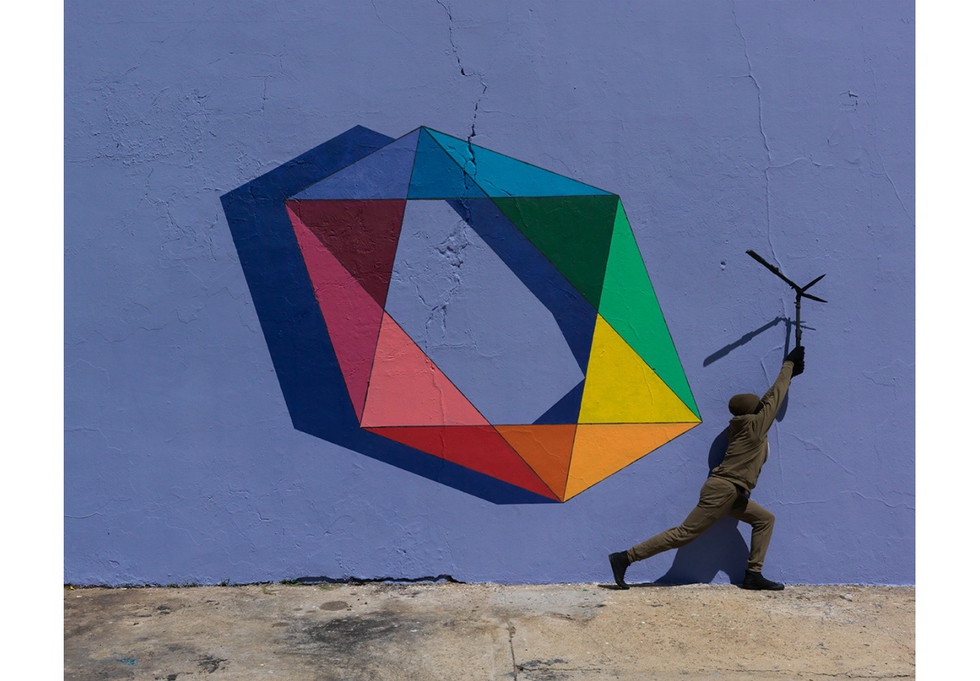
ENIGMATIC, playful, even absurd these works by artist Robin Rhode are sure to tantalise and challenge the viewer.
Her exhibition, Paths and Fields: A Solo Show By Robin Rhode, at the Stevenson includes drawings, sculpture, painting, video, installation and performance and thus showcases both the craft and meaning-making inherent in his art. The exihibition runs until March 4, 2017.
It is difficult to determine a definite or coherent direction to the exhibition as a whole as there is a no set theme or methodological focus. Yet this constitutes its strength as it opens up the possibility for a certain exploratory depth.
The first room references his performance and theatre direction at the New York Times Square performance of Schoenberg’s “Erwartung” in 2015 with his circular drawings and video of forests – one being a lamentation of loss and the other a more joyous account of the forest. This installation of sorts is flanked by two drawings that speak of the artist’s interest in drawing as a kind of rhythmic and direct art and as a return to the fundamentals as it were.
What is particularly pleasing is the artists’ combination of various spaces. That is, there are often photographs of actual performers in relation to two dimensional drawing and paintings which together weave a dance of sorts, a kind of figure in motion in relation to these drawn and painted forms which then set up a dialogue and actually bring the more abstract, minimal surfaces to life. For the artist is certainly not, it appears to me, to be interested in pure abstraction in its own right, recalling rather the Art Povera movement with its interest in the subversive, performative and sub culture. And one certainly gets the sense of this raw directedness. Take for instance his “Stone Drawings” or his “Trees (negative)” where the simple, almost course use of charcoal or chalk respectively appear to create surfaces that are rich in texture and movement through line and mark making.
I also enjoyed his burnt key sculpture where a simple key is found placed within a hardened rock surface of sorts. What is the key used for? Why was it found in such a condition? More significantly, what door(s) does it open? Perhaps these questions are somewhat answered in his “Lavender Hill” series where doors are played against a figure that dances in relation to these rectangles. The real and the imaginary create a conversation and the serial nature of some of his works set up a narrative, an incantation of time, sequence and movement. In this respect, his work has a musical and dance-like quality, moving in and out of real three dimensional space and the apparent illusion of a two dimensional surface.
There is a curious wall paper image of a skier caught in an odd pose in what is obviously non-skiing country. This absurd image provokes a sense of the senseless and the idea that perhaps one cannot come to terms with reality. For here reality is called into question – clearly it is staged; clearly it cannot be and so one is betwixt between the existential crisis of simply not understanding and the happy ignorance of playing with that which cannot be. In this sense, the image is actually quite liberating and appears to suggest that while one cannot necessarily create an edifice of philosophical truths alah philosophers of the Enlightenment, that very realization allows one to imagine images of an alternative reality and thus philosophy becomes rather a means to deconstruct existing languages (or images), rather than simply regurgitate what is thought to be sense and truth.
Rhode creates a dialogue between real figures and pure form and this sense of “stage design” inherent in his sequenced images that build as one moves from one image to the next in numerical sequence, subtly adding to the drawing/painting is quite original and the viewer may feel a sort mathematical harmony in this well conceived iteration. At the same time, there is a humorous element to all of this as the images – all very carefully constructed with respect to light and shadow – capture a dancer responding to form and colour as if they were real things or objects of the world! This tension, if you will, highlights one may surmise the dichotomy of a serious, abstract interest and a subversive subculture of the street. A resolution is perhaps found in the idea that art can theoretically be found anywhere. I am here reminded of that wonderful film Amadeus where the young Mozart draws from his clashes with one character by using her distressed voice aimed to undermine him, as the basis for a character in one of his operas.
Read more.