
Review: Once we were leaders exhibition
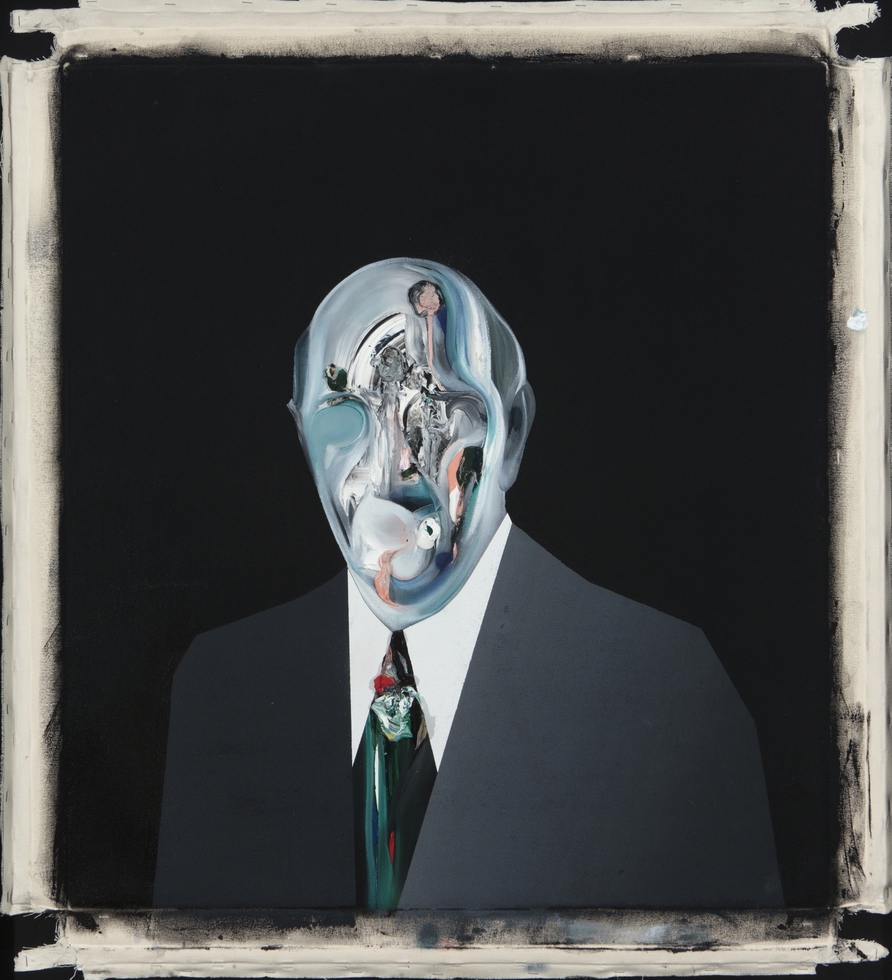
HAVING recently exhibited this body of work at VOLTA, New York, Ryan Hewett’s unmistakable style combines strong formal rigour as well as expressionistic looseness. In a sense this means his series of portraits, generally leaders in the world of South African politics over the last one hundred years, contain both an element of obvious references to icons, while maintaining a richness of surface as swathes of thick impasto – rich, organic, congealed paint – have an almost organic appeal.
Some of the works on show are presented in a rather interesting way as the canvas is stretched and mounted on board and then covered over with a glass sheet. Other paintings are not that “lucky” and invite the viewer closer inducing the desire to touch the thick oils. What is particularly pleasing is even with the apparent haphazard brushwork of the impasto globules, there is still a sense of flesh and gentleness and yet more surprising, one never loses a sense of who the portrait represents. At other times, an alternative mode of consciousness may invite a sense of morphing into some sort of fictitious character – potentially monstrous, almost Bacon-like or a sense of Lucian Freud’s pulsating, thriving flesh as it were.
Some of the portraits are of figures such as Jan Smuts, Hendrik Verwoerd, Mandela and Oliver Tambo. It is unclear if the artist is a social commentator here or simply interested in the language of paint and the inherent distortions that may occur through paint and the various glazes that he uses. For irrespective of who is represented one notes the same recipe, for lack of a better word. Smeared paint defining the facial features, unmistakable caricature-like elements defining the essence of the icon; hard-edged, rather flat articulation of the rest of the bust – the suit – and a non-descriptive, subdued background. Perhaps in this overall treatment – beyond the obvious point that it thus forms a coherent, consistent body of work – Hewett is equalising all these figure heads in the attempt to make the comment that the past, that history is merely an abstract concept so that there are no features as such that can easily separate fact from fiction, the ethical from questionable behaviour and ideas. This reading is supported by the fact that no one icon is singled out with differential or special treatment – the pages of history are glossy, scientific and impartial. The smudged-out faces reiterate the point: all such leaders in their field probably have as much doubt, deception and moral issues as the next.
The artist appears to capture the essence of his subject, yet in his expressive distortions of the face and flat rendition of the bust, one gets the sense that his icons are not as real and pivotal as one is lead to believe. Could it be that those in positions of power are not as significant as it may seem? Could it be then that the story seldom told is perhaps more pivotal, more central than the obvious locus and seat of power? In which case, we are enjoined not to worship the throne where others sit, not to ooh and aah and gape and gasp at the movements (and ideas) of those who apparently wield power and control, but that the onus is on ourselves to take care of our own consciousness and set of values. At the very least, it will limit mindless small talk. For in the over compensation for seeming political talk, is there not a lack of self-examination or ventures into the unknown territory of what constitutes the nature of matter, the very energy that weaves existence into being? And is not Hewett’s vaporised faces just that: an incantation into the abstract world of thought, rather than the merely literal and descriptive.
It’s rather difficult to pull off portraits of well-known figures without a sense of “another big five” kind of scenario, yet Hewett’s unique language and the tendency toward abstract colouration combined with the succulent thickness of the paint mark this series as curiously provocative. It is, however unclear whether one gets lost in the historical narrative or the sheer brilliance of colour, form and gesture. Perhaps in the consistent visual language, the weight of history is traversed, yet never quite concealed. Just as the portrait of Chris Barnard, one of the few non-political characters, suggest that South Africa can be a country of great innovation and ingenuity, so the political arena need not be replete with ideological distortions and the like.