
Three Solo shows: Turiya Magadlela, Bronwyn Katz and Herman Mbamba At Blank Projects
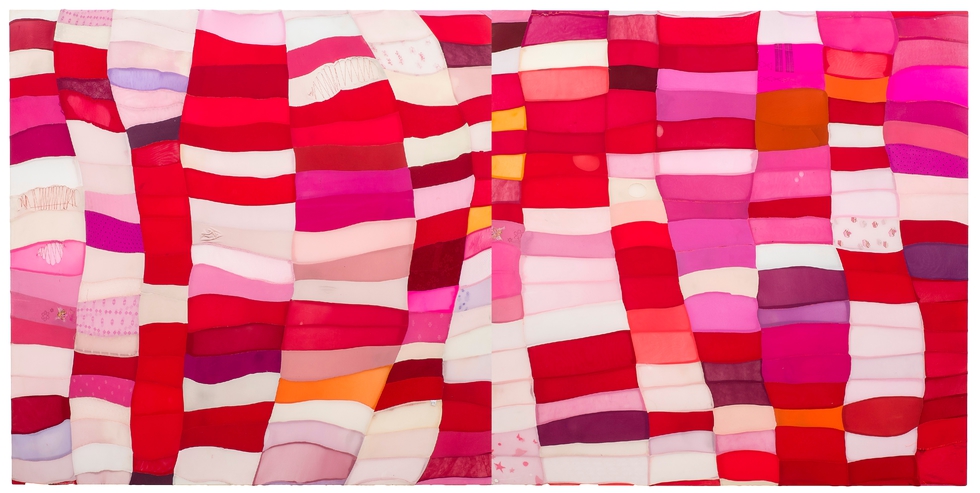
RELOCATED to larger premises in Woodstock, Blank Projects is a wonderful space for art. In this premier show, three artists present distinct methods and processes that may be understood in various ways. Magadlela’s “Wabana lapho isifebe, wangena kuso” employs pantyhose on canvas to great effect; Katz uses bed wiring and Mbamba uses acrylics within the context of torn pages from Norwegian fashion magazines.
What is particularly pleasing about the gallery is the experimental space that it offers. For each artist offers quite innovative and striking aesthetic devices. Magadlela’s work exhibits an uncanny colour sense as the stockings literally weave stretches of colour, intermingle, overlap and yet are not frayed and torn. The effect is an abstract design of sorts and while the titles appear to indicate a content, there is no precise formulation of what these abstract shapes may mean. While the images appear simply constructed and easy, in fact it is well conceived and crafted.
The capacity to take one material, such as pantyhose and recontextualize that within an artwork speaks to the notion that art is precisely that capacity to use things in new ways. Such is the creative act in art and elsewhere, namely the ability to see things in new ways and reinvent the game, as it were. In art, this may refer to formal shifts. But such shifts, then change the meaning we attach to things. Rather than simply the functional, an article of clothing may be perceived as having creative and aesthetic potential. It is at that point that materials then lose their signification as simply that thing – essentially, perception is thus stretched, forming new patterns and sequences both conceptually and materially. In accordance with the artist’s aim, such methods may deal with subject matter as outlined in the gallery leaflet of “articulations of personal experience of woman and motherhood, and narratives from black South African history”.
While there is a reading of Katz’s work where notions of place, space and memory are invoked by these wire sculptures and discarded skeletons as it were from mattresses, I simply enjoyed the sculptures curiously hanging like paintings, on other levels. One might perceive the quirkiness of the springs, their coiling motion as references to string theory in physics, where it is theorised that there is an underlying vibration behind and within all things. One might conjecture that the out of kilter rectangles with odd lines of force and pockets of space at various intervals refer similarly to the idea of the equivalence of energy and mass. For this relic of a bed that once supported a human frame, this bed that has now become a cultural object/subject as art is an instance of minimal form, a kind of conceptual nothingness. Now nothingness is not nothing as such, for space teems with life as it were and mass/matter appears to have a counterpart in antimatter. One could sleep on these ideas and in the dream world further distortions of space, mass and time are at play. The “bed” then may allude to many possible interpretations. Having said that, the gallery leaflet proposes this analysis: “having sourced most of her materials from the various places where she has lived, she employs them as signifiers for these locations, informed by the ready-made forms and structures of the salvaged bedsprings and mattresses”.
Mbamba’s work is also interesting. His large-scale painting in acrylic on canvas with a very wordy title, is quite strong. Again, I hesitate to attach a specific meaning. Perhaps this is the nature of art as many are wont to say that it is purely subjective. While there is a kernel of truth to that, the history and theory of art, that is, the parameters of the game in rather crude terms, defines the logic and excellence of a “good move” or not. One senses from the movement in the painting – implied of course – that indeed the play of line, colour and brush mark suggests Mbamba’s aesthetic or language is unique. Yet that, if you will subjective expression is always in relation to the discipline of art, theory and practice. The beauty is that the discipline evolves (and often questions itself, better known as deconstruction). His smaller paintings on adverts from Norway, communicate his sense of alienation in that country and such sentiments are communicated with the fresh paint on the glossy advert surfaces, a combination that suggests a sense of discomfort and incongruence.