
Time to Re-imagine ACH & CCI Contributions
IT’S A New Year and there is a lot to be achieved in the upcoming months across the arts, culture, and heritage sectors and the creative and cultural industries. For example, we have a strong working draft of the Revised White Paper (RWP) on Arts & Culture (2016) on the table and the entire industry must offer their inputs to strengthen the policy framework which will inform debates regarding our industry for years to come.
I have spent time during the last few months considering the value of the creative and cultural industries (CCIs) during my review of the RWP and in co-writing a publication report on ‘Realising the Economy of the Imagination and the Creative and Cultural Industries: Options for South Africa’, which will be published in due course.
One of the standout lessons from all the subject matter reading is that when there is a real commitment from both government and business, the CCIs can be a significant source of socio-economic development and growth. While this may seem logical to some, it has taken several decades, sustained policy advocacy and a large and expanding body of scholarship to establish this argument internationally.
Recent thinking on the subject is conveyed in a unique report released in December 2015 by EY, ‘Cultural Times – The First Global Map of Cultural and Creative Industries’ – the first global survey quantifying the global economic and social contribution of the industries.
The study analyses 11 cultural and creative industries (CCI) sectors, including: advertising, architecture, books, gaming, movies, music, newspapers/magazines, performing arts, radio, television and visual arts. It finds that the top three employers are visual arts, books, and music (EY, 2015). The report shows that the global CCI revenue generated accounts for 3% of the world’s Gross Domestic Product (GDP) or a total of $2,250-billion creating a total of 29.5 million jobs globally, or 1% of the world’s active population, surpassing the combined 25 million jobs created by the automotive industry in Europe, Japan, and U.S. (EY, 2015).
The Europe and the Asia-Pacific regions have been the most successful at capitalising on the CCIs, which contribute over $700-million to each of the region’s GDPs, creating in excess of 7 million jobs (EY, 2015). South Africa is aligned with this trend. A recent report on the mapping of South Africa’s creative industries (DAC, 2014), found its creative economy sector contributed over R90.5-billion to the national economy or 2.9% of the GDP in 2013/14.
We are currently trying to imagine a creative South African economy sector that can expand that figure from close to 3% to between 5 and 7%; and to grasp what it would take to achieve this type of contribution by the ACH sectors and the CCIs. The forthcoming report ‘Realising the Economy of the Imagination and the Creative and Cultural Industries’ aims to do just that by showing how there is real potential in establishing and managing CCI clusters. The upcoming report will showcase some of the thinking on clusters and how they could be a critical route to supporting the CCIs. It also argues that we need to exploit South Africa’s intersecting traditions of ingenuity, innovation and creativity better. Watch this space for the completed report.
Update on SACO activities
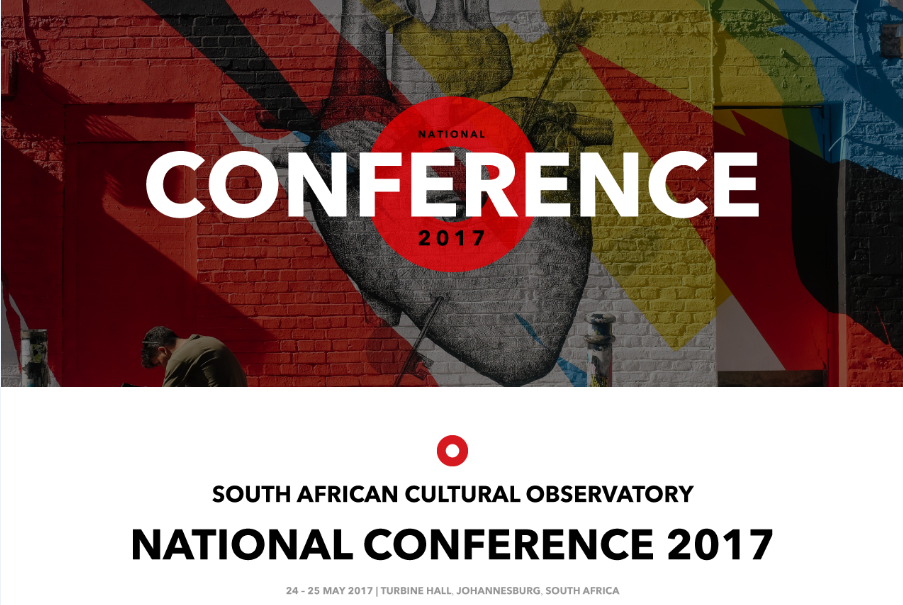
The final quarter of 2016 was rather busy and saw us wrap our 2016 domain workshop series and start preparation for the SACO’s 2017 second National Conference, which will take place over 24 & 25 May at the Turbine Hall in Johannesburg.
The conference will explore the interface between the creative economy and development – an emerging global trend and point of policy consideration as countries and cities try to activate their creative economy to create jobs, build liveable cities and spaces, and grow local and national economies.
We are currently seeking papers and presentations for the conference under one major theme: ‘The Creative Economy & Development – Perspectives from the Developed and Emerging Economies’. In support of the major theme, papers, presentations and panel discussions are invited within the following thematic areas:
- International, Regional, BRICS and African Experiences and Best Practice
- The creative economy: Value and development across the CCIs
- Policy, Research & Mapping
- The South African Experience: Nuances and new ways of thinking
Submit an abstract – we would love to include your views and voices on the programme.
We are also searching for our next cohort of outstanding young scholars interested in doing research on South Africa’s arts, culture and heritage sectors and the creative and cultural industries – applications close today, so apply here.
In December we also visited the Cultural Policy Observatory Ireland – and our Research Director, Dr Sybert Liebenberg, established a sound working relationship with Irish Observatory and will be exploring a deeper, more productive relationship.
Some of his findings include that the Cultural Policy Observatory of Ireland, presents a unique proposition and scenario for the South African CCIs. Similar to the South African society, Irish society is confronted with issues pertaining to post-colonial views of knowledge and culture. In this regard, there are similar discourses evolving around the issues of culture and breaking with a colonial past in an attempt to develop a legitimate indigenous view of cultural and knowledge.
The second major interest for policy practitioners within the South African CCCIs is the scenarios that the evolution of the cultural management landscape in Ireland presents to South Africa. Ireland presents a scenario where culture played an important role in developing a vibrant cultural and creative industry, which greatly contributed to the expansion of the Irish Cultural Tourism offering and the rejuvenation of urban landscapes.
Our Chief Research Strategist Prof Jen Snowball also in November completed a research report on Cultural Employment in South Africa. She and Serge Hadisi found that CCIs are attracting increasing attention worldwide as potential drivers of economic growth, innovation and job creation; which has bearing on South Africa, which has very high unemployment rates.
Results show that cultural and creative occupations contribute significantly to employment in South Africa, making up 2.93% of total employment in 2014 (443 778 jobs), which is slightly more than mining, and about two thirds of the number of agricultural jobs. Time series analysis has shown that, while cultural employment can grow faster than non-cultural employment, it is more volatile, being significantly affected by economic downturns. Compared to non-cultural jobs, more jobs in the cultural sector are in the informal sector, especially for women. There are also significantly more freelance (or “own account”) workers in cultural employment. The percentage of black African, coloured and Indian or Asian people employed in cultural occupations is somewhat lower (81% in 2014) than in non-cultural occupations (89%). Read the report here to find out more.
We also have some exciting new research that we will publish over February and March, so keep reading our newsletter, website and like us on our social media platforms.
Until then, enjoy the January edition of The Cultural Observer.
Your Culturalist,
Prof. Richard Haines
South African Cultural Observatory: CEO