Data matters for the future of South Africa’s creative economy, but it must mean something too
BY
10.12.25
The setting was a stadium — not your typical venue for a creative-economy conference. But then, the creative and sports economies are not typical industries. They are dynamic, expressive, and increasingly central to how we work, play, and imagine the future.
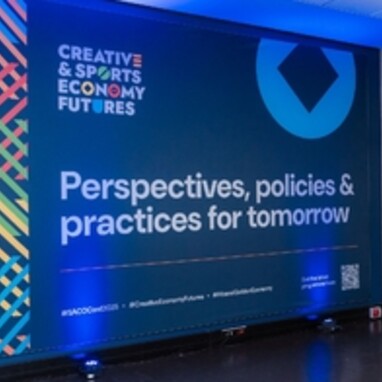
Just think of the game last weekend, and the one today, the book you reading, a series you are watching or the gig you’re planning on going to. Culture is our lives. On the 4th & 5th of November at the 5th International South African Cultural Observatory (SACO) Conference at the DHL Stadium in Cape Town, more than 400 delegates from artists, academics, and athletes, to policymakers, and entrepreneurs, gathered under one iconic stadium roof to ask a profound question: What comes next for South Africa’s creative and sports economies?
The theme, “Creative and Sports Economy Futures: Fresh Perspectives, Policies and Practices,” was both celebration and challenge. Ten years after SACO’s establishment by the Department of Sport, Arts and Culture (DSAC), we’ve completed the hard work of measurement – counting the contribution, employment, and economic weight of creativity and culture. The next decade must be about meaning translating data into better policy, deeper investment, and tangible inclusion.
The numbers are compelling. Between 2021 and 2023, the combined cultural, creative, and sports industries or the CCI&S sector contributed approximately R271 billion to South Africa’s GDP, or about 4 percent of the national economy. These sectors employ 1.4 million South Africans, more than agriculture or utilities, and they are growing. The sports economy alone expanded by over 11 percent in 2023, outpacing several traditional industries.
These are not abstract figures. They represent people, the designer in Durban, the festival organiser in Makhanda, the film editor in Soweto, and the coach in Kimberley, all part of a knowledge-based economy built on creativity, expression, and innovation. Yet, as we reflected in Cape Town, numbers are not neutral. They tell us not only where we are succeeding, but where transformation remains unfinished.
While Black workers make up nearly three-quarters of those employed in the CCI&S sector, ownership and leadership are still unequally distributed. While women represent almost half the workforce, gender gaps persist in pay, access, and recognition. In 2025 women still do not own half of the businesses in the sector. That’s why this conference and SACO’s research matters. Data allows us to move from anecdote to evidence, from advocacy to accountability.
Over two days, the conversation stretched from the deeply personal to the strategically global. We debated AI and automation, intellectual property, digital piracy, the gig economy, cultural governance, and festival futures. Panels explored how technology is reshaping imagination itself, and how artificial intelligence can serve as a co-creator rather than a copycat.
A major shift this year was SACO’s inclusion of sport in its research. As the DSAC has recognised, sport is culture in motion – choreography, design, storytelling, and national pride fused together. The conference’s opening panel, “At the Intersection of Sports, Arts & Culture,” and the powerful “Women in Sports” session showcased how these sectors share not just infrastructure and audiences, but aspirations: visibility, equity, and transformation.
Looking ahead, three imperatives emerged clearly from the conference:
First, inclusion. South Africa’s creative geography remains uneven. Provinces like the Eastern Cape, Limpopo, and Mpumalanga brim with talent but lack access to infrastructure and investment. Bridging these divides will require digital connectivity, skills development, and new regional hubs for production and collaboration.
Second, ethics. The rise of AI and global platforms challenges long-standing notions of authorship and ownership. Who owns the outputs of a machine trained on millions of human works? How do we protect South African creativity from being scraped, remixed, and sold back to us? Updated copyright and data-governance frameworks are essential if innovation is to remain both fair and free.
Third, imagination. Beyond policy and economics, we need a renewed belief in the creative power of this country — in its ability to innovate, inspire, and heal. The creative economy doesn’t need another decade of justification, it needs a decade of design. Design means deliberate choices: rethinking education so that arts, entrepreneurship, coding, and ethics are taught side by side; investing in digital transformation that is inclusive, not extractive; and ensuring that our creative and sports ecosystems are recognised as engines of South Africa’s soft power and identity in the world.
The Department of Sport, Arts and Culture has heard the sector’s calls — for improved infrastructure, coherent governance, and sustained investment. Using SACO’s Cultural Information System, DSAC is strengthening its capacity to plan with precision, grounded in data rather than instinct. But policy alone is not enough. There is a need of a shift in narrative from seeing art and sport as “nice-to-haves” to understanding them as core to national resilience, youth development, and social cohesion.
A stadium is a space of both discipline and dreams — where excellence meets endurance. It was the perfect metaphor for a sector that trains as hard as it imagines, that performs, builds, and innovates even when the odds seem high.
The data tells us we are on the field, not on the sidelines. The question that was framed at the conference now is: what game are we playing for the next decade?