

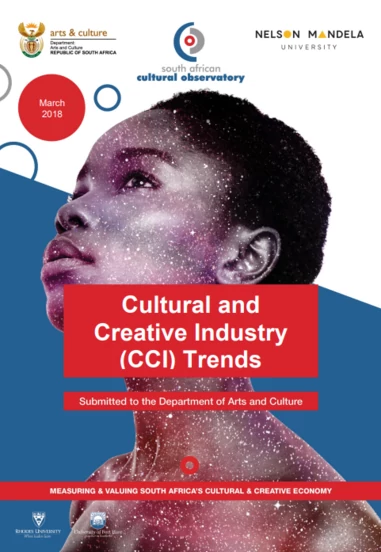
The aims of this report are to (i) Identify and discuss important international economic trends for the cultural and creative industries over the last decade; (ii) Assess the importance of the identified trends in the South African CCI context, and (iii)
Overview
The creative economy is increasingly being recognised for both its intrinsic cultural values and its potential to contribute to economic growth, employment creation, and poverty reduction. The cultural and creative industries (CCIs) have been affected by important economic trends over the last 10-years internationally as well as in South Africa, particularly related to online and digital environments (and more recent developments in Artificial Intelligence), but also including new ways of managing and supporting the sector, the rise of freelance and platform work, and the increasing importance of international trade in cultural services.
The aims of this report are to (i) Identify and discuss important international economic trends for the cultural and creative industries over the last decade; (ii) Assess the importance of the identified trends in the South African CCI context, and (iii) Discuss the potential challenges and opportunities for South African CCIs in light of these trends.
A mixed-methods approach was used, combining quantitative data analysis from sources such as UNESCO, UNCTAD, and South African economic statistics, with qualitative insights from an online focus group of South African CCI stakeholders. The study also used partial equilibrium modelling, based on a Cultural and Creative Industries Satellite Account, (including a forecasting component, from 2025- 2029, to track the recovery and likely future growth of South African CCIs by domain.
The analysis identified five major international economic trends affecting the CCIs, both international and locally: Techno-Economic Trends, including digital platforms, NFT and Blockchain technologies, and generative AI; Work and labour market trends, including the “gig” economy, hybrid working, and the role of industry associations; International trade trends, including diversity in cultural trade, the rise in services trade as cultural products dematerialise, and South-South cultural trade; Trends in managing the Creative Economy, including changes in intellectual property and copyright, cultural policy, public funding for the CCIs, and cultural leadership; and Demand side and cultural consumption trends, including digital cultural consumption, the role of social media and user-generated content, and environmental sustainability and ethical consumption.
Most cultural sectors (domains) in South Africa showed a reasonably quick recovery from COVID-19. The most notable growth is seen in the Audio-Visual and Interactive Media domain, which significantly accelerates post-2020 – a trend that is expected to continue in the future, fuelled by productivity gains from new production and distribution methods. However, Visual Arts and Crafts, and especially Books and Press, have declined in terms of economic growth, a trend which is expected to continue in the future despite some recovery from the pandemic
This report concludes by identifying the opportunities and challenges that each of the identified trends is likely to have for the South African economy, and suggested actions that can be taken by both government and the industry itself are to capitalise on the identified trends.
These suggestions include investment in digital and internet infrastructure to capitalise on the opportunities offers by the techno-economic production and consumption trends, and the development targeted funding and training support for emerging technologies. Being able to leverage the opportunities offered by digitalisation and new technologies, like generative AI, depend on both access to funding, and skills and education on how the new technologies can be used effectively by the CCIs. Other suggested actions include strengthening intellectual property and copyright laws to enable creatives to monetise their work more sustainably, and support for hybrid work models and findings ways of enabling freelancers to access social protections.
Related Reports


Join Our Mailing List