


This report highlights the growing significance of creative industries, their role in driving economic growth, creating employment, and promoting South Africa’s cultural identity in global markets.
Overview
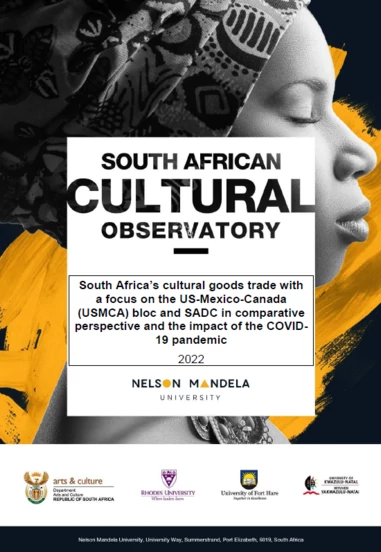
Chapter 3 provides an analysis of South Africa’s cultural goods and services trade, highlighting trends, international and regional trade relations, and growth opportunities for the creative economy. It mainly focuses on the post-COVID-19 pandemic impact and the rapid adoption of technology and Artificial Intelligence (AI) in the creative sector. The assessment of international and regional trading partnerships reveals that South Africa’s cultural exports are predominantly directed to the USMCA (60%), SADC (18%), and the Middle East, while cultural imports are primarily from the EU, East Asia, and the USMCA. The analysis further indicates that while trade surplus is evident under USMCA, trade with SADC exhibits structural imbalances with potential for growth. The quantitative analysis, using the intra-industry trade (IIT) and trade complementarity index (TCI), indicates that South Africa has strong intra-industry trade with the USMCA across domains such as Visual Arts and Crafts, Books and Press, and Performance and Celebration. While minimum specialisation is observed with SADC, significant potential exists for trade expansion.
Trade performance by domain indicates that COVID-19 adversely affected South Africa’s cultural goods trade. This is evident in the period between 2020 and 2023, where a sharp decline is observed across all domains. However, in 2024, Visual Arts and Crafts, Books and Press, and Performance and Celebration exhibit recovery. In addition, the growth rate of cultural exports shows that the Books and Press domain significantly increased across different regions, including Africa, Latin America and the Caribbean, and the Pacific. On the other hand, the Visual Arts and Crafts domain demonstrates an increase in regions such as Europe, Latin America and the Pacific. However, domains such as Cultural and Natural Heritage and Performance and Celebration exhibit a declining trend in Asia, the Rest of Africa, and Latin America. The analysis further indicates that exports of creative services in developing economies have significantly grown, accounting for about 57.63% of creative services trade in 2024.
Digitisation and the adoption of AI tools have emerged as key drivers of the transformation of creative content production, consumption, and distribution. These tools offer several opportunities, such as enhanced productivity and expanded market access; however, concerns remain regarding ethical compliance, data privacy, skills gaps, and digital exclusion. The analysis reveals that developing economies such as South Africa are increasing their adoption of digital transformation, boosting their share in global creative services. In contrast, developed nations such as the US remain dominant players in the creative international economy.
Overall, this report highlights the growing significance of creative industries, their role in driving economic growth, creating employment, and promoting South Africa’s cultural identity in global markets. Challenges such as insufficient digital infrastructure, financial and regulatory constraints continue to persist, and this sector’s growth is hampered. As such, there is a need for robust trade policies that align with industrial strategies. These include digital infrastructure investments and unlocking the creative economy’s potential through harnessing AI. Furthermore, intra-African or cross-border trade frameworks such as AfCFTA enhance market access for cultural goods and services, promote economic growth and improved competitiveness worldwide, and thus aligning national trade policies with these frameworks is crucial for the development of the South African creative economy.
Related Reports


Join Our Mailing List