

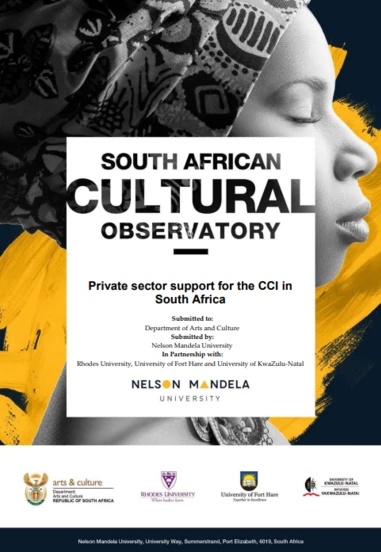
This paper adopted a desktop study to discuss key debates and issues pertaining to private sector funding of the CCI in South Africa.
Overview
A key orientation of the Department of Sports, Arts and Culture’s (DSAC) strategy is to unlock the potential of the Cultural and Creative Industry (CCI) to substantially contribute to economic growth and job creation in South Africa, which can be attained if the sector is adequately supported. This paper adopted a desktop study (examining relevant literature, reports and extracting Corporate Social Investment (CSI) information from Top 100 Johannesburg Stock Exchange (JSE)-listed companies’ annual Integrated Financial Reports for the 2016-2018 reporting years) to discuss key debates and issues pertaining to private sector funding of the CCI in South Africa. This is undertaken in the context that the continued dominance of public sector funding for the CCI raises sustainability concerns, and that it is imperative that private sector funding is leveraged by the arts and culture sector to reduce dependency on government funding. This will further unlock the potential for the CCI to contribute to economic growth, create jobs and contribute to social cohesion.
The key themes and debates identified in the literature review indicate an economic orientation/ shift in the arts and cultural sector. However, it is noted that the CCI is unlike other economic sectors since the core benefits are normative in nature and, therefore, values and benefits go beyond economic aspects. Furthermore, there is limited literature, if any, that provides actual amounts of private sector funding to the CCI and to specific domains/ genres. Private sector biases, however, are indicated towards events and festivals, the visual and performing arts, shows and exhibitions, film and television, and training and educational programmes. Furthermore, larger and more established organisations and events are supported. This is of concern since in the CCI smaller businesses dominate, many of which are individual-based and operate on a freelance or contract basis. Thus, the CCI encounter challenges to attract private sector funding. Governments advocate for private sector funding to reduce reliance and/ or complement public funding as well as develop the CCI. On the other hand, the key reasons why the private sector supports the CCI is to leverage economic benefits. The main form of private sector funding support is CSI, which is a requirement for large companies in South Africa. However, the main reasons why companies engage in CSI activities are also aligned with economic benefits. A key theme is also related to driving innovation, where it is noted that private sector funding is more effective in this regard. The crowding-out effect of public funding in dissuading private sector investments in the CCI is also highlighted. There is, therefore, the need to reduce government funding to increase private sector funding. A critical issue raised is that private sector support can increase corporate interests/ influence and reinforce inequalities, which can undermine transformational efforts.
Private sector funding is relatively low compared to public sector funding in South Africa. The primary sources of private sector funding for the CCI in South Africa were mainly from direct funding, especially CSI programmes. An assessment of the CSI spend among the Top 100 JSE-listed companies reveal that the amount of funding is declining, both in terms of actual amounts and spend as a percentage of net profits after taxes. Mining, financial services and the retail sectors spent more on CSI than the other sectors. The main areas of CSI spend are in education, health-related activities, infrastructure/ community project development, small business support, environmental programmes, and job creation initiatives. It was noted, however, that these areas have the potential for arts and culture integration. In terms of arts and culture specifically, 34% of the companies in 2016, 32% in 2017 and 33% in 2018 provided support. An important mechanism of private sector support is also joint ventures and partnerships, specifically with BASA, ACT and NAC. The main sector appears to be the banking sector, with key initiatives being Standard Bank Arts and Culture and Nedbank Arts Affinity programmes. There is some evidence of international private sector funding in South Africa as well. The variations in the amounts of funding corporations provide for CSI are substantial. Concern was noted in terms of more established organisations receiving the bulk of the funding and the same organisations benefitting every year. A preference to support events and festivals was also evident.
The main recommendations emanating from this study are the need to target larger corporations to support the CCI and for training in the arts and culture sector for organisations and individuals to attract public sector sponsorships/ funding. In terms of research, more effort needs to be placed to improve data quality and information to permit calculations of the proportion of the funding that can be attributed to the private versus the public sector, and better understand the motivations and impacts associated with private sector funding. Further research is also required to understand the crowding-out effects in South Africa, since this could be a reason for the private sector preferring to fund other areas compared to CCI, as indicated in relation to the Top 100 JSE-listed companies’ CSI spend analysis. The private sector is influenced substantially by economic considerations in relation to funding decisions, therefore, more attention should be paid to making a business case for why investments in the CCI are important, and how these can benefit specific corporations. There is also a need to develop strategies or engage more effectively with the public sector to shift spending from established CCI businesses and organisations to new and emerging ones with a more spatial spread, especially to contribute to achieving broader transformational imperatives. The impacts of the COVID-19 pandemic on private sector funding, especially the massive economic recession that the pandemic has triggered, needs to be monitored and appropriate strategies developed to assist the CCI. This should include identifying companies and corporations that are likely to benefit economically from the pandemic to support the CCI financially. The CCI’s role in contributing to dealing with the pandemic should also be highlighted and integrated into initiatives. Organisations and individuals attempting to leverage private sector funding need to be trained on how to access funding and attract sponsorships.
Related Reports



Join Our Mailing List