

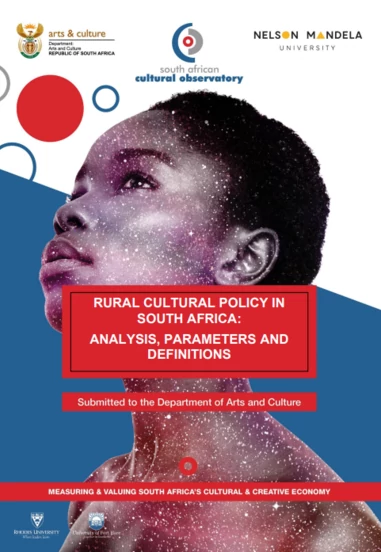
This document analyses and assesses rural cultural policy in South Africa, and focuses specifically on defining how cultural policy applies to rural areas, and what form of cultural policy will be most suitable for the South African context.
Overview
This document analyses and assesses rural cultural policy in South Africa, and focuses specifically on defining how cultural policy applies to rural areas, and what form of cultural policy will be most suitable for the South African context. The document critically assesses the standard approach towards cultural policy, which is (in part) based on the approach that cultural and creative industries are vehicles for development. We point out that more work is needed regarding the rural cultural sector, for three reasons: (a) rural policies are often not visible enough in local government practice and are subsumed under different departments, and various private and public development agencies, (b) rural creative industries and heritage practitioners are located in the informal sector and therefore less visible, and (c) rural cultural and creative industry development for rural areas mostly takes place in urban zones. In order to assess regional dynamics, the document develops a basic profile of CCIs in each province in South Africa, using datasets from SACO and DAC, the South African Heritage Resource Agency, and StatsSA. As this document contends, cultural policy encompasses far more than the creative and cultural sector alone, but includes heritage, and more particularly, intangible and tangible rural heritage and tourism. The results of this document suggest that cultural and heritage policy in rural areas of South Africa is clearly a collaborative process which should be present in all facets of local government planning, and link up more pertinently with private strategies and entities.
Related Reports



Join Our Mailing List