

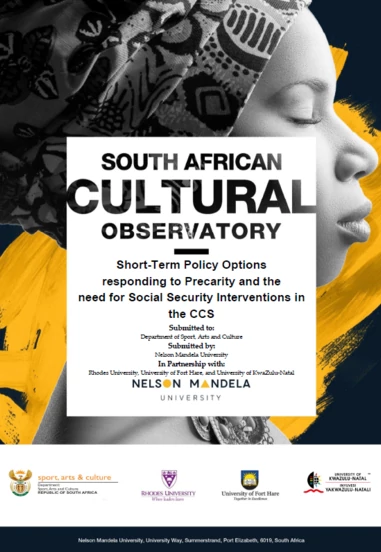
The central aim and objectives of this report are to expand and diversify key aspects of the initial and exploratory research report, mainly the online survey, and the main policy recommendations and findings.
Overview
The initial exploratory research report on Precarious Work and Social Security in South Africa’s Creative and Cultural (CC) sector, ranged relatively widely and moved somewhat beyond its brief. Paradoxically, in so doing it opened further avenues of inquiry and uncovered tangled issues. A meeting with DSAC and SACO in December/November 2022 during the first research phase, already pointed to the need to expand and deepen the research. This was confirmed in a workshop in late January 2023 at which the exploratory report was presented, and its strategic implications and recommendations spelt out. The workshop also considered the scope and nature of future research and associated policy interventions, both in the short and longer-terms. A subsequent follow-up meeting between the research team leaders and senior DSAC member in early March 2023 clarified further the linked research and policy trajectories for DSAC.
This research report on Precarious Work and Social Security in the CC sector and creative economy in South Africa links with and expands certain aspects of the original report. It also sets the scene for a line of future inquiry on the dynamics of precarity in the CC workforce and the kinds of social protection that could be provided by a state facing a range of deep structural challenges ranging from the delayed investment in state infrastructure through to mass unemployment, high inequality and fiscally constrained growth. In addition, envisaged policy interventions will be taking place in a somewhat fragmented and historically conflicted terrain, with mostly underdeveloped institutional and associational structures. Smart partnerships, coordinated interventions, and an innovative use of public, private and third sector resources are required to lead to meaningful outcomes.
This study looks to supplement certain key aspects of the exploratory report, most especially in regard to the policy and implementation considerations, and to provide momentum for future policy and research processes. The study has three main objectives. Firstly, it provides the first stage of a refined online survey with more direct emphasis on the kinds of social protection measures required. Secondly, it provides additional economic analyses of contractual labour in the CC sector and examines the selection dynamics in regard to pensions and UIF programmes by cultural and creative workers and practitioners. In the third place, a summary policy framework most especially for shorter term initiatives, i.e. quick wins for the Department of Sports, Arts and Culture are provided.
The study is divided into eight chapters. The introduction discusses the issues at play, outlines the Terms of Reference of the study, and thus describes the nature and scope of the research to be done. There is also a short summary of the constituent chapters.
Chapter one provides a comparative and international literature review of atypical and precarious labour in the artistic, cultural and creative sectors. Notwithstanding the fact that precarity of creative labour is not a new phenomenon, it is the intensification thereof that is apparent even in a number of developed countries. While the C-19 pandemic had a deleterious impact on the CC sector globally, there are other factors in play. For instance, cultural capital and class positions can and still do make a difference in accessing work and opportunities in the sector. The ongoing digitization of the CCI sector and the continued shift to gig work has reshaped a good deal of cultural and creative work. In addition, the growing emphasis on intellectual property and copyright as part of what Standing (2016) calls the new rentier capitalism, has presented new contradictions for local artists and creative firms in securing a just percentage of their rights. A number of the digital platforms pay nominal or modest revenue to the relevant national governments but secure largely unmonitored access to a range of possible business including that associated with the creative economy. And in some instances as Cunningham (2014) points out precarity is negotiated and managed by some creative workers and practitioners and in some sectors. But with the downscaling of the welfare state project, there is less investment in the public arts and cultural space than previously, and more emphasis on consumption than production of arts and creative work.
Moreover, the creative economy is changing and seemingly expanding, partly through an emphasis on a kind of democratization of creativity and innovation, and the extension of digital platforms into new realms, such as the metaverse (Haines & Lotter 2023). And with AI impacting on processes of artistic creativity, there are new uncertainties for artists and creative workers. This in turn adds to the challenge to nation states: How to ensure that high artistic and creative endeavour is nourished and sustained.
In addition, the value of associations and trade unionism for artists and cultural workers in responding to conditions of work is considered, as are the shortcomings thereof. Furthermore, there is a compact discussion of efforts by certain associations and trade unions globally to adopt new technologies (such as social media) and approaches to help artists and cultural workers in their struggles.
The rather modest body of South African scholarship on the precarity and conditions of work is also examined. In general, the emphasis falls more with issues of precarity in the CC sector. There is something of dearth of academic research on social protection matters in regard to the CCS and the creative economy.
The research methodology and methods are discussed in chapter two. A mixed method approach is deployed. Desktop research includes a range of secondary literature and accessible documents. The economic modelling exercises are based primarily on data generated from the Labour Market Dynamics in South Africa (LMDS) survey. This is a longitudinal household survey conducted by Statistics South Africa (Stats SA) to provide a comprehensive understanding of the country's labour market dynamics. It collects detailed information on labour market activities, including employment, unemployment, job search, job mobility, and earnings, among others. The data is collected into a single file and occupations and industry classifications are used to identify creative and cultural workers. The prime mode of analysis of the data is via a time series approach. The times series data is aggregated using pivot table techniques.
Further quantitative material is generated via an online survey of select artists and cultural workers with a blend of questions on the experiences of precarious labour, and on the views on structured social protection and unemployment income support. This empirical material is supplemented by a several semi-structured interviews and informal meetings (direct and online) to explore and/or discuss potential short-term policy interventions in regard of precarity amelioration and social protection in the CC sector and creative economy. Where necessary such insights are cross-referenced with existing sets of interviews from the exploratory research study.
Chapter three considers of the international and policy context and developments, including certain best practices cases. In effect it supplements the specific literature review contextualized in chapter two. In chapter there is a quite substantive de facto literature review, most especially in regard to the status of the artist (in the widest sense), and the working conditions of artists and cultural workers and developing and/or reasserting relevant social security measures.
Chapter four provides a short overview of the socio-economic policy context in South Africa and relevant trends and issues. A compact summary of the social protection system/regime is also provided. This links up with certain of the economic analysis in chapter seven in regard to Pension, UIF and contractual issues confronting the artistic and creative workforce. The chapter then moves on to consider select aspects of DSAC cultural policy such as the Revised White Paper on Arts, Culture and Heritage, as well as the DTIC-DSAC collaborative production, the Masterplan for Cultural and Creative Industries (DTIC 2022). These productions are considered, particularly in regard to their provisions to improve working conditions for artists and creative workers, and recommendations on the subject of social security protection in the CCS. Thereafter, the associational and institutional landscape and the modest efforts at unionization, are compactly examine. The seemingly fragmented CCS terrain is discussed. The relevance of conflict management approaches in future policy processes are raised subsequently in chapter eight.
Chapter five discusses the qualitative empirical material. Several semi-structured interviews and discussions were held to supplement the insights provided by the seventeen interviews with eighteen stakeholders of the exploratory study. These interviews and discussions consisted of three one-on-one interviews, and three sets of online discussions, two of which were tripartite discussion, and the other meeting a one-on-one discussion. Furthermore, apart from these online discussions, a DSAC-SACO workshop was held in late January 2023, and an informal meeting of the SACO research team and DSAC held on 1 March 2023. There was also an online meeting with Assitej regarding the context and nature of the e-survey and questionnaire for their beneficiaries. These meetings and discussions were focussed primarily on key issues and items for the short-term policy and research options section
Chapter six analyses the data provided by the online survey. The electronic survey was carried out via the Survey Monkey platform. This survey was a trimmed and revised version of the one carried out for the exploratory research report. It was sent to Assitej beneficiaries and reinforced with additional respondents accessed by referral processes. On the first deadline of the survey, a robust number of 267 interviewees had responded – an encouraging sign given the tight timelines for the exercise. This survey provided an improved coverage of details regarding the question of social protection measures for the CC sector.
In chapter seven, a new quantitative economic analysis, based primarily on data generated from the Labour Market Dynamics in South Africa (LMDS) is applied to the CC sector. The analysis use a times series approach which is aggregated by the use of pivot table techniques. The LMDS survey comprises a longitudinal household survey conducted by Statistics South Africa (Stats SA) to provide a comprehensive understanding of the country's labour market dynamics. It collects detailed information on labour market activities, including employment, unemployment, job search, job mobility, and earnings, among others. The data is collected into a single file and occupations and industry classifications are used to identify creative and cultural workers.
On the question of unemployment income and pensions there are a number of workers operation outside of formal social security protection. The analyses show that a high percentage of workers do not pay UIF -- with Black creatives contributing the least to UIF and Coloured creative contributing the most of the designated population groups. In addition, despite the rather small old age pension given by government, less than half of creative workers contribute to a private pension fund. This is a significant amount and suggests the urgency for state and private sector interventions here.
In recent years the percentage of workers paying UIF has shown an upward turn, while there has been a downward turn in regard to contributions to private pension funds.
These figures indicate if anything the reinforcement of informal contracts and gig work within the South African creative economy sectors
The second sub-section examined the situation of gig workers within or with links to the creative economy. Currently, they are classified typically as independent contractors and thus not considered employees. This means that they are not entitled to the same benefits and protections as employees, such as minimum wage, sick leave, or unemployment insurance. This is problematic and needs to be addressed and prioritized by government.
Gig workers contracts vary considerably with the industry, particular company, and/or the platform with which they are engaging. Some gig workers in South Africa may be represented by trade unions, associations, or advocacy groups, who work in part to promote the rights and interests of gig workers. However, the legal status of gig work in South Africa has not been settled, and debates continue on how best to protect the rights of gig workers, and how to ensure that they receive fair compensation and improved working conditions. A further point, raised by certain respondents is that quite often contracts are poorly drafted, or even verbal in nature, making it difficult to contest such legal arrangements when conflicts arise.
The tabular evidence suggests that if anything gig working is growing phenomenon in South Africa, and that fair and equitable representation is important.
Chapter eight deals with short-term policy options and interventions. The chapter outlines a range of short-term and policy options and actions steps, and related action steps. These interventions allow for meaningful integration of policy actors and accompanying research. Insights and identified solutions have been informed by the preceding analyses including the modest but focussed set of interviews and discussions that supplement the existing body of strategic interviews, focussed groups and meetings.
The policy options and interventions presented, are designed to be implemented in a relatively short space of time. There is an emphasis on ‘quick wins’: practical and achievable projects and processes.
The policy options envisage DSAC to take the lead in the inter-departmental initiatives in the Inter-Governmental Relations (IGR) space. Further specifications and prescribed procedures could be outlined in a ‘toolbox’ exercise.
A number of institutional projects and interventions are discussed, including the following:
• Establishment of Special Private Sector Fund for CC Sector on PP Lines.
• Formation of Intergovernmental Committee for Social Protection in the Cultural and Creative Sectors and Creative Economy.
• Formalization and Establishment of Special Archives and Records Management System/Programme for Social Protection for CC Sector.
• Policy Toolbox for DSAC and national government
• International Reference Group for Social Security for Artists and Creative Workers
• International Conference on Social Protection Responses to Precarity in the CC Sector
• Digital Cultural Policy Group
As discussed above, each project should articulate well with the other specified projects and interventions.
In addition, an accompanying programme of potential research projects is put forward to provide a set of applied research to provide useful information for the policy process for DSAC and inter-governmental stakeholders. These include a bespoke toolbox to facilitate DSAC interventions in regard of Social Security policy design for the CC sector; a research audit of the associations, trade unions and institutions of the CC sector; relevant research in regard to the production and stakeholder engagement for Green and White Papers; cooperatives as a means of ameliorating precarity in the CC workforce; and Gig work and the creative economy.
The research management aspect as well as the question of securing national and leveraged funding to ease the fiscal burden on DSAC is also considered. It is also advised that seed funding and additional funding for research be secured to anticipate the demands for information in respect of the institutional projects listed above.
In conclusion, this expanded study has brought to bear a range of rich empirical material, supplemented the original exploratory study, and confirmed the pervasiveness of precarity in the CCS in South Africa. With countries from Ireland to New Zealand, currently firming up new interventions in the regard to the improvement of the working conditions and social protection of the CC workforce, it is the time for DSAC singly, and in conjunction with strategic partners, to embark on a coordinated course of action in this field.
The report has identified a number of specific interventions and projects that can be embarked upon in the shorter term with achievable goals and with multiplier effects. The question of resource constraints has been taken into consideration and options for mitigating such factors specified. Such interventions may lead to further unanticipated and propitious outcomes. Accompanying such a programme would be a series of selected and supportive research studies which would provide an evidence-based dimension to the overall process and contribute to the reflexivity of the policy making and implementation. Such policy interventions will have a positive impact on the CCI sector and contribute inter alia to the implementation of key recommendations of the CCI Masterplan and the Revised Masterplan. Moreover, these endeavours will develop the creative economy and its workforce and stimulate the creation of new sustainable jobs.
Related Reports


Join Our Mailing List