
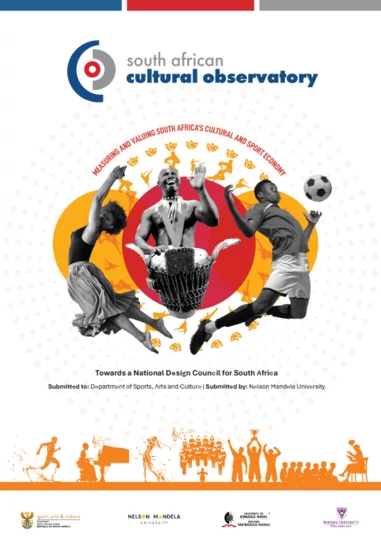
This research report examines the question of a mooted establishment of a professional National Design Council, or similarly conceived body.
Overview
This research report examines the question of a mooted establishment of a professional National Design Council, or similarly conceived body. Such a body will help re-position and prioritize design within the country and the economy and help shape the country’s design direction through a National Design Policy. The Design Council would foster an engagement with the design sector at industry, business, and policy levels to help develop more internationally competitive businesses. The Council would advocate for a design-driven future for the country and to champion the importance of design in addressing pressing socioeconomic and environmental challenges.
A professional National Design Council would play a central role in the conceptualization and/or implementation of a National Design Policy and the promotion thereof. It would also help with the further institutionalization, coordination and promotion of the constituent design economy and its sub-sectors and impact positively on the creative economy and national economic growth and development.
This report is an exploratory and will consider the potential for formal pre-feasibility and feasibility processes regarding the nature and means of forming such a Council. In addition, the report should lay the foundation for the provision of a catalytic institutional structure for economic, industrial, and social development in South Africa.
The formalization and/or institutionalization of the constituent design sub-sectors in South Africa has been raised on occasion within the established sub-sectoral professional design bodies in the country, and within the relevant national departments and subsidiaries. At national government level, the project has been considered by the Department of Sports, Arts (DSAC) and its largest entity the National Arts Council (NAC) and it is understood that preliminary work has been carried out. Furthermore, the DTIC (Department of Trade Industry & Competition) has also considered the question of the organizational coordination of the sectors of the design industry and economy.
Design councils help improve people's lives through design by:
-
- Educating: Sharing examples of great design and providing evidence of its value
- Collaborating: Bringing together designers and non-designers to share expertise and transform the way they work
- Advocating: Championing designers and the design industry, and working to make it easier for designers to design for the planet
- Researching: Commissioning evidence-based research to demonstrate the power of design
- Developing programs: Creating programs to help businesses, public service providers, and others understand how design can help them
- Advising: Advising on policy and shaping the debate around the modern economy
- Creating a framework: Using a framework like the Double Diamond to help designers and non-designers understand the design process
The design policy process involves identifying goals and selecting the policy instruments to achieve them. The implementation process involves putting the policies into practice, which includes defining an implementation structure, decision-making, and target group behaviour.
Design councils and bodies have a variety of aims and objectives, including:
-
- Supporting businesses: Design councils can help businesses use design to create more inclusive products and services.
- Improving public services: Design councils can help local authorities transform public services.
- Encouraging community change: Design councils can help communities change the places they live for the better.
- Promoting better design: Design bodies can promote better design through a variety of means.
- Recognizing design as a creative act: Design bodies can recognize design as a creative act and advance the theory and practice of design.
- Transferring know-how: Design bodies can transfer know-how in the design field.
In recent decades, the economic, developmental, and social importance of the collective design sector has received more coherent and considered attention with economic policy circles and debates. Formal design sectors include Architecture, Interior, Product, Graphic, and Fashion Design. But there are new cross-sectoral and digital-oriented design fields that have burgeoned. The design economy embraces a range of fields and activities within and without the creative economy. These range from design-intensive fields such as web design, animation to designers and design-engineers in manufacturing production including automotive and aerospace sectors.
Historically design has been supported for its value-adding capacity regarding products and services. This was expanded with the maturing of the industrial revolution and the search for foreign markets for manufactured goods. Indeed, with the evolution of contemporary capitalism it has taken on more substantive and complex roles. As Julien (2017) argues design in current times is conditioned by and actively shapes economic systems, with its impact and reach ranges from urban strategies to commercial processes and public policy making (ibid.). Nevertheless, as Nasimi et al (2021) argue, the impact of the design factor on the development of a country’s economy is often underestimated or even overlooked by planners and analysts.
Interestingly, Churchill’s war government established the Industrial Council of Design (ICOD) in 1944 to support the economic renewal of the nation. The country looked to design ‘to rebuild, innovate and instigate growth’ (Design Council 2018). ICOD was in effect the first national design council. Over time it became the UK Council of Design over time and has become an international touchstone regarding the professional institutionalization and coordination of design sectors.
The Council observed in 2013 that:
Great design can change lives, communities, and organisations for the better. It can create better places to live, bring communities together, and can transform business and public services. Design is a way of thinking that helps small, medium, and large organisation alike, social enterprises and charities change the way they work (Design Council 2013).
The late 2000s and early 2010s saw a significant/dramatic expansion of design-intensive activities on the global and national stages.
Among the trends was the embedding of design into the city, and the accompanying linkage with the creative economy. The reasons are diverse. For one, as Pirinen et al (2022) point out: ‘Design is increasingly deployed by governments and cities to address social and policy-related problems and to develop public services and organizations towards more citizen centeredness.’
Secondly, cities have interacted with differing design sectors from architecture to fashion and design awards have accompanied such shifts. Additionally, with greening and sustainability influencing global, national, and sub-national design activities and thinking, there has of late been a surge in the emphasis on inclusive design for urban environments, promoting new kinds of dialogue between design fields.
A further and related trend is the ongoing internationalization of certain design companies and the increased importance of global design value chains.
These shifts have been accompanied by the burgeoning of international design award processes and discourses. Indeed, in 2020 the International Council of Design was moved to note and warn of the potential dangers of ‘the proliferation of Design Awards around the world’ with certain of the awards considering the surface appeal of a design or product rather than considering the behind-the-scenes professional work involved (ICOD 2020).
The increased specialization and complexity of design fields has intersected with initiatives and production practices looking to establish synergies and new outcomes and products. Such developments while resulting in an increased range of professional associations focussing on new and more traditional specialisms, have also reinforced the need for more coordination and collaboration between such fields. This has reinforced moves to establish broader national structures to collectively further the interests of the differing private, public, and civil sector stakeholders in the design economy to find mutually beneficial opportunities and assist in resource mobilization.
Developing countries have not been as proactive or systematic at implementing national design policies and establishing and maintaining national design organizations. The international evidence suggests that those states who are vigilant and proactive in the embedding, institutionalizing, and promoting design develop quicker, are generally more economically and industrially competitive in world markets and have expanded to new and energizing ways of utilizing design to plan for a better and more sustainable society and future.
Related Reports


Join Our Mailing List