

This report explores the role of CCIs and Sports in the provincial economies. This is important to support the development of the industries at ground roots level and assist in the development of policy that is appropriate to the local conditions.
Overview
The Cultural, Creative and Industries Sports Sector (CCI&S) is a priority sector in South Africa. The industry is also prioritised at provincial levels in South Africa, with each of the nine provinces having departments of Sports, Recreation, Arts and Culture. The industry accelerates growth in provincial economies, both directly and indirectly and plays a critical role in job creation and poverty reduction.
While the sector remains pivotal to the job creation and poverty reduction targets, it remains plagued with challenges that continue to hamper the sector’s growth prospects. This report explores the role of CCIs and Sports in the provincial economies. This is important to support the development of the industries at ground roots level and assist in the development of policy that is appropriate to the local conditions. Literature on creative economy and regional factors shows that understanding the physical aspects of a place is important to the development of the sector role of local factors that determine the development of the sector (Anna Szopa).
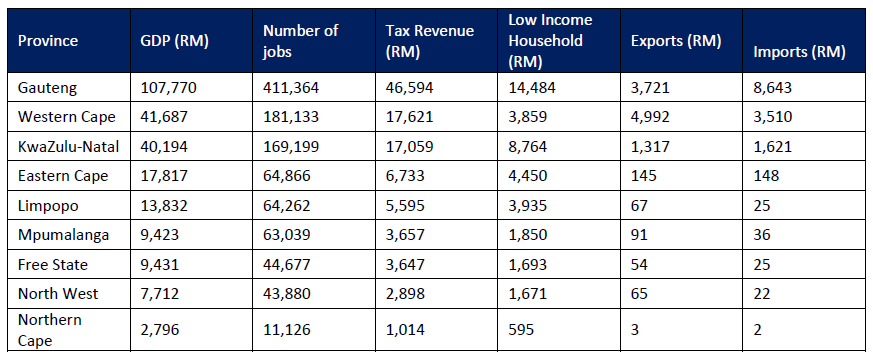
The analysis shows the role played by provinces in relation to the creative and sports industry. The analysis highlights that Gauteng remains a dominant region, contributing 43% to the CCI&S GDP. The Western Cape and KwaZulu Natal also contribute a significant share to CCI&S (17% and 16% respectively.
Gauteng is also the largest contributor to employment, followed by Western cape and KZN. What is also evident in terms of employment in the industry is that cultural and sports workers in these three provinces tend to have secondary and tertiary qualifications. Notable progress is noted in terms of employment of women and youth in the industry, although most jobs are still occupied by males.
With regards to trade, Western Cape has the largest proportion of cultural and sports exports, while Gauteng has the largest share of CCI&S imports.
In addition to GDP, trade and employment, the evaluation shows the importance of the industry in terms of reducing poverty. This is measured through the income generated by the industry that accrues to low-income households. It is interesting that while the industry in Western Cape contributes to low-income households, the value is relatively lower compared to other variable and lands the province in the fifth spot. Further, the industry contributes to public finances through a wide range of taxes, thereby increasing government revenue.
On the domain basis, the Design and Creative Services, followed by Sports and Recreation, were the main contributors to the provinces’ performance on terms of GDP, employment and trade, poverty reduction and tax revenue.
On the domain basis, it can be observed that Design and Creative Services, followed by Sports and Recreation, were the main contributors to the provinces’ performance on terms of GDP, employment, and trade.
Related Reports



Join Our Mailing List