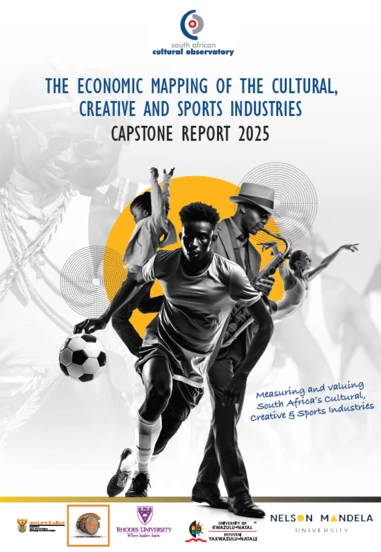
The Economic Mapping of the Cultural, Creative & Sports Industries in South Africa
2025 Capstone Report

2025 Capstone Report
CCI&S represent a dynamic intersection of cultural capital, creative production, and socioeconomic development. Mapping these industries provides the empirical foundation needed to understand their economic footprint, labour dynamics, and growth potentia
In today’s increasingly globalised world, Cultural, Creative Industries and Sports (CCI&S) are emerging as crucial sectors of national economies that significantly contribute to leisure and entertainment and stand as pillars of innovation, competitiveness, employment and development. The global share of the creative economy was estimated to be around $2.3 trillion in 2024, contributing 3.1% to GDP and employing 6.2% individuals. The creative industries are known to create more employment for women and youths than any other sector, which is a great potential for Africa, given that the continent has over 60% of its population under 25 years old. The CCI&S could therefore constitute a new avenue for the million job seekers who enter the job market monthly on this continent.
In South Africa, the economic and social footprint of these industries is already noticeable. For instance, in 2020, South Africa’s cultural and creative industries contributed 3% to Gross Value Added (GVA) and accounted for 4.1% employment in 2019. As the global economy continues to recover following the easing of pandemic-related restrictions, these sectors are projected to rebound, benefiting from renewed tourism, increased cultural exchange, and domestic consumption, with employment trends further underscoring the sector’s importance. The cultural and creative industry generated just under a million jobs in 2022 in an array of occupations, including film makers, designers and actors (SACO, 2022). The sports also make an important contribution in South Africa’s GDP. The industry is estimated to add about R50 billion annually to GDP (DSAC, 2022). Jobs are created in the sports industries themselves and in related industries, stimulated by tourism. Trade statistics reflect a similar potential of the CCI&S in South Africa, with exports of cultural goods rising from 0.25% of cultural exports to 0.47% in 2018 (SACO, 2022).
Given the importance of the cultural, creative and sports industries to the South African economy, it is of interest to the government to leverage its potential both for economic growth and environmental sustainability. In this line, digital technologies are increasingly becoming a defining force in reshaping cultural expression, creative industries, and sports around the world. The digital age can make it relatively easier for African culture, with digital tools now structuring how stories are communicated, music is shared, how games are played, and how art is monetised. There is also a pressing need to combat climate change as temperatures increase, altered rainfall patterns, and extreme weather events pose a danger to public health, food production, biodiversity, and water security (DEA, 2019). The CCI&S can drive the economy to environmental sustainability through platforms that shape public opinion, promote eco-conscious behaviours, and lead by example through sustainable practices within their productive practices.
10.58 MB | .PDF | March 2026
3.32 MB | .PDF | March 2026
2.59 MB | .PDF | March 2026
0.92 MB | .PDF | March 2026
0.98 MB | .PDF | March 2026
1.35 MB | .PDF | March 2026