


This report analyses the potential of the South African film industry to be a driver of development and growth, including an analysis of existing strengths and challenges, with a view to the development of a business plan for the sector.
Overview
Worldwide, the potential of the cultural and creative industries to contribute to economic growth and job creation is increasingly being recognized. An important part of the sector is the film and television industry, which also plays important roles in fostering national social cohesion, and international place-making. A few developing and emerging economies have been successful in growing their film and television sectors, most notably, in Nigeria (“Nollywood”) and India (“Bollywood”).
This report analyses the potential of the South African film industry to be a driver of development and growth, including an analysis of existing strengths and challenges, with a view to the development of a business plan for the sector.
South Africa has a long history in film and television sector production that has resulted in a high level of technical skills and capacity on the supply side. However, very few South African feature films are produced for release in cinemas, and those that are tend not to do well at the box office. It is the rare exception that is successful internationally. The production of feature films thus tends to serve the international market, supported by the DTI film and television production and post-production incentives. This market, clustered mainly around Cape Town and Johannesburg, earns valuable foreign exchange, creates jobs for local film industry professionals, and plays an important role in skills transfer. Nevertheless, it does not contribute towards the telling of South African stories for South Africans, by South Africans, and Hollywood films tend to dominate the box office. There are some initiatives in place that support the development of South African films, such as those run by the National Film and Video Foundation (NFVF) and the Emerging Black Filmmakers Incentives offered by the DTI. However, transformation in the industry has been slow, partly because the film industry (like many other sectors in the creative economy) can be difficult to break into, and results in short-term contract work, rather than full-time permanent positions. This characteristic also limits opportunities for on-the-job training, as internships are limited, and production companies rarely have the time or resources needed to train them. Skills audits show that, because of the lack of industry linkages and experience, film school graduates are often poorly prepared for the world of work and thus struggle to find jobs.
The vast majority of South Africans watch television, and reported that they would like to see more quality South African content. The demand for movie tickets shown in cinemas is constrained by the distance that many South Africans must travel to access them – most cinemas are located in town or city centres – and by the limited purchasing power of many poorer South African households. Feature film distribution in South Africa is highly concentrated, with the two main distributers (Ster Kinekor and NuMetro) controlling most of the market. The television market is dominated by the SABC and Multichoice. While online streaming is still quite limited due mostly to high data costs, it does have potential for future growth. The success of Nollywood was originally founded on the “straight to DVD” market, rather than distribution through cinemas or television, which is something South Africa might consider. Television production can also provide an important gateway for the development of new film professionals, as it offers a lowercost training ground where actors, producers and directors can gain valuable experience.
It is important to realise that while many people only see and evaluate the end product, the sector is made up of an entire value chain that begins with the conceptualisation of the end product. This ideal is developed and refined until the end product is eventual enjoyed by audiences. This value chain is graphically depicted below: Even though the value chain graphic is simplified, it does show how much effort goes into the final product. It is also important to realise that South Africa can capture value (employment, profit, growth etc.) along this value chain.
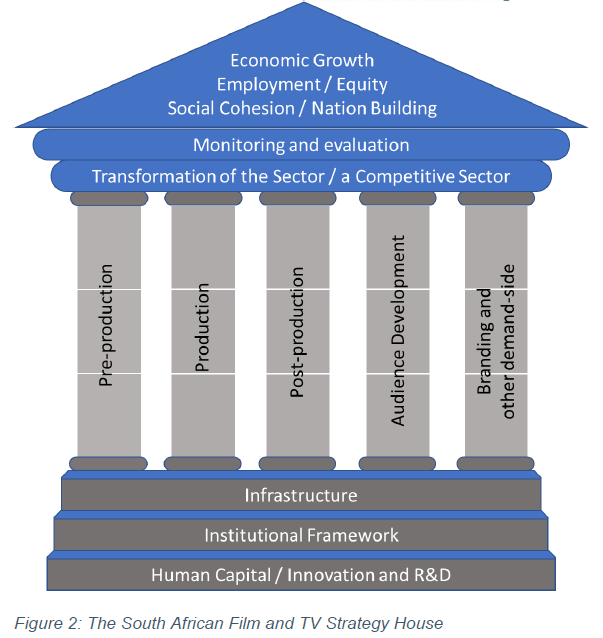
The South African Film Industry Business Plan is the result of a wide-ranging and critical review of international and national data and research, as well as consultations with film industry practitioners and policy makers. It is based on “foundational layers”, “Pillars” and an apex or goals and impacts. These largely correspond to the value chain presented below (Figure 1).
The impact of a transformed and competitive sector will contribute to the NDP’s goals generally and will have a positive impact specifically on Economic Growth; Employment, Equity; Social Cohesion and Nation Building (Figure 2). Transformation of the industry through support for skills development and financing of emerging black filmmakers will be accomplished. A well structured and effectively implemented monitoring and evaluation system will ensure that the impact will be realised.
The foundational layers are conditions that are essential for the efficient and effective development of a South African film and television industry. These are:
Human capital development Innovation and R&D (Research and Development). Ongoing industry research is necessary to insure that the South African film industry is well-placed to develop and distribute high quality products that meet the market demand
Development of Infrastructure that takes advantage of existing capital and facilitates the transition to digital production and distribution;
Development of an Institutional Structure at provincial and national level that takes into account existing clusters, develops new ones, and incorporates public and private sector stakeholders;
Five main pillars have been identified and grouped into supply-side and demand-side interventions. These are:
Supply-side interventions that support producers at each stage of the value chain;
1. Pre-production
2. Production
3. Post-production
Demand-side interventions;
4. Develop audiences, facilitate their access,
5. Market South African film and television locally and internationally as a distinctive and recognisable brand.
The apex objectives are:
Transformation of the Sector
A Competitive Sector
These must be monitored through a national Monitoring and Evaluation framework.
Ultimately, the impact of the development of the film and TV sector must contribute to:
Economic growth
Employment and management equity
Ownership equity
Social cohesion
Nation building
These are diagrammatically presented in Figure 2:
Each of the pillars considers all the parts of the film and television production value chain:
Pre-production (including development and conceptualization); Production; Postproduction; and Audience Consumption (including circulation and delivery).
The Business Plan also takes into account that film production companies need different kinds of support at each stage of their development:
Tier 1 - Experienced filmmakers who have a proven track record for developing and producing theatrically released feature films;
Tier 2 - Filmmakers with limited experience but who have developed and produced a theatrical feature films, television fiction, documentary, short films and/or commercials, now seeking to venture into feature film development and production; and
Tier 3 - New entrants into the industry, particularly recent film school graduates from historically disadvantaged backgrounds.
Unlike many other plans, this plan pays attention to the demand side and distribution channels of the industry. It is acknowledged that one of the critical success factors in the development of film industries in other countries has been the presence of a strong and stable local demand. A key success factor is thus the development of a unique and recognisable brand for South African film, and the effective marketing of the brand, both
locally and internationally.
The Plan also acknowledges the importance of spatial distribution of “film hubs” and film cities for the equitable development of an industry that draws on the cultural diversity of South Africa. The potential production of film and television in indigenous African languages for specific regional markets is also explored.

Related Reports






Join Our Mailing List