

This Guide is intended to be used with Version 1 of the South African Festival Economic Impact Calculator (SAFEIC), a free online tool developed by the South African Cultural Observatory specifically for cultural festivals and events.
Overview
Tourism events attract “new” money into the impact region and create direct and indirect impacts through re-spending of the initial injection. Economic impact studies attempt to answer the question, “If the event had not taken place, what would the loss of economic activity to the impact area have been?” An economic impact study thus calculates all the additional economic activity that takes place in the region as a result of the event or festival.
Economic impact studies can be used for valuing all kinds of events and organisations, but they work best when large numbers of tourists from outside the impact area (the town, city or municipality hosting the event) come specifically to attend a festival or event.
This is because normal expenditure by local residents and expenditure that is likely to have taken place anyway, should not be included, since their spending is likely to have occurred anyway. The same applies to sponsorship from inside the impact area, since it is likely that, even if the event had not taken place, this money would still have been spent in the impact area on something else (Crompton et al, 2001; Crompton, 2006; Snowball, 2008).
While economic impact is a powerful way of demonstrating the market activity associated with the event, the methods used need to be valid and based on realistic, verifiable data. It also needs to be acknowledged that economic impact studies measure only one aspect of economic value: they are not able to measure longer term or deeper cultural and social (sometimes called “intrinsic”) cultural values, or long run growth impacts. Rather, economic impact studies focus only on short run spending impacts.
However, if conducted correctly, economic impact studies can be useful partial valuation tools.
The three broad categories of economic impacts can be summarized as:
Full Impact (FI) = Cultural impact (C) + Long Run Growth Impact (LRG) + Short Run Spending Impact
(SRS).
Economic impact studies do not address C or LRG, but focus on SRS.
This Guide is intended to be used with Version 1 of the South African Festival Economic Impact Calculator (SAFEIC), a free online tool developed by the South African Cultural Observatory specifically for cultural festivals and events. SAFEIC was developed by two experienced cultural economists: Prof Bruce Seaman from Georgia State University, Atlanta, Georgia, and Prof Jen Snowball, Chief Research Strategist of the South African Cultural Observatory, and a professor at Rhodes University. The tool is based on a regional economic impact calculator developed specifically for cultural events in the US, and adapted for South Africa with the assistance of the original modeller. The Guide gives both a theoretical basis and some practical advice on how to use SAFEIC, and it is highly recommended that it be carefully read before the tool is used.
Economic impact requires complex analysis. While the calculator is intended to address most of the major conceptual challenges, all festivals and other cultural events have unique properties that can only be addressed by an individual study of your event. Because this calculator allows you to address the major components of an economic impact study, your results using the calculator will be reasonable and defensible estimates of the actual economic impact.
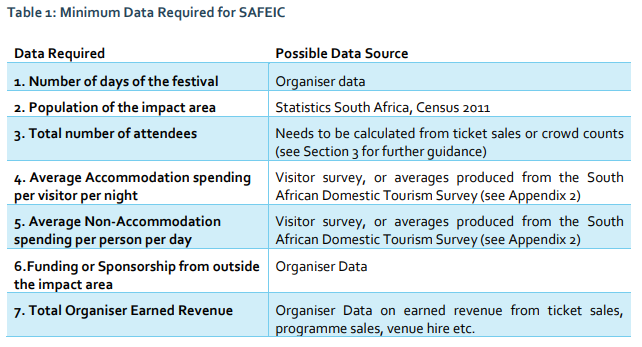
To run SAFEIC, a festival or event requires a minimum of seven pieces of information (Table 1). Ideally, some of this information should come from a visitor survey, but if a survey is not possible, SAFEIC uses default values and provides guidance on things like average visitor spending.
Related Reports

Join Our Mailing List