

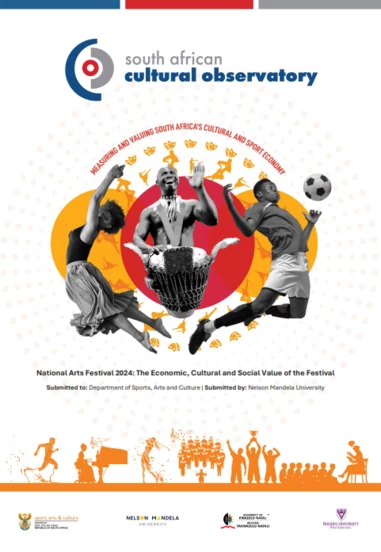
The purpose of this report was to provide an assessment of the social, economic and cultural impact of the 2024 National Arts Festival, reflecting also on its contribution to the South African cultural ecosystem on the occasion of the 50th anniversary of
Overview
The purpose of this report was to provide an assessment of the social, economic and cultural impact of the 2024 National Arts Festival, reflecting also on its contribution to the South African cultural ecosystem on the occasion of the 50th anniversary of the Festival. Research methods included an audience survey (in-person interviews, and an online option), interviews with Festival organisers, and an online survey and in-person focus group discussions with artistic producers.
NAF 2024 audience members who responded to the survey were mostly from the Eastern Cape (63%, 35% from Makhanda), with the next most common provinces being Gauteng (13%) and the Western Cape (12%). Visitors to the NAF attended an average of 6.5 ticketed shows, and 1.9 free events during an average stay of 3.4 nights and 4.2 days. The NAF has a cohort of loyal festinos, who attend the festival year after year, with 26% having attended the Festival 10 or more time previously. However, there is also a new, younger cohort: 17% of respondents were attending the NAF for the first time in 2024.
The generally high ratings obtained by the Festival for most of its offerings were maintained in the post-COVID period: 80% of festinos rated shows on the Curated programme 4 or 5 out of 5 in terms of value for money, with similar ratings for Fringe shows. The exception was the Craft Markets, which received lower ratings than in the past (57% of festinos rating this aspect 4 or 5 out of 5).
The larger audience sample size in 2024 (1028 responses) allowed the analysis of activities and opinions amongst differed festino age groups. For example, the “young, social and price sensitive” group attended fewer ticketed shows and more free events and are most interested in the “vibe” and social scene that the NAF offers, and had higher ratings for the Craft Markets. On the other hand, the “older planners and show focused festinos” attended more tickets shows and had higher spending patterns, and rated shows on the Curated programme most highly. The survey also showed that the NAF continues to play an important role in providing access to the arts and building inter-cultural understanding and social cohesion.
Artistic producers who responded to the online survey were almost evenly balanced between the emerging (89%) and established (11%) categories in the demographic age range of 18-25 (13%), 26-35 (33%), 36-50 (38%) and 51-64 (16%). The gender distribution was male-dominated (67%), with 30% female artistic producers. Regarding race categorisation, 57% were black artistic producers, 8% were coloured, and 3% were white. The Focus Group Discussions (FGD) were attended by a general representation of emerging and established artistic producers, who have produced creative works at NAF for 2 years and above. The analysis, therefore, of the socio-political contribution of NAF to the South African arts and culture industry draws from these extensive experiences of artistic producers.
The analysis of the online artistic producer survey and FGDs highlights that NAF is an important institution in the training, development, and networking of artistic producers and audiences across the divide. Furthermore, the data revealed that NAF is considered by the artistic producers as a site for artistic expression, nurturing, reflection, international networking and standardisation of creative works and standards in the country. However, the artistic producers raised challenges related to programming and limited financial benefits to artistic producers during and after the festival.
The economic impact of the NAF 2024 of the economy of Makhanda was calculated to R57,9 million, and on the Eastern Cape, R131,8 million. The decline from previous years can be attributed to factors such as a rising inflation and poor economic growth, which has generally decreased domestic tourism. In addition to the Festival itself, the NAF has also become an important local hub for social development in Makhanda: In June/July 2024, the NAF sourced R6,7 million from the Social Employment Fund that created 1604 direct jobs in addition to the 247 work opportunities related to the Festival itself.
Related Reports

Join Our Mailing List