

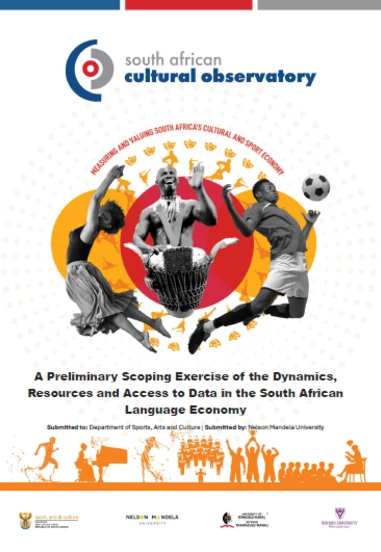
This report is the first of four linked reports. It should be seen as pilot report and lays the groundwork for the three subsequent reports. These four reports also represent an extension of the original Economics of Language report.
Overview
This report is the first of four linked reports. It should be seen as pilot report and lays the groundwork for the three subsequent reports. These four reports also represent an extension of the original Economics of Language report (SACO/Haines & Gouws 2022).
The four reports will provide the collective research, applied research and policy recommendations to point the way for an operating agency for the South African Language Practitioner’s Council (SALPC) which can implement and run the Council in a productive and cost-effective manner.
The SALPC was legislated for in the South African Language Practitioners’ Council Act (Act No. 8 of 2014) which aims to establish a Council for the protection and promotion of language practice; regulate the training of language practitioners and conceptualize and controls the accreditation and registration of language practitioners. The SALPC is also intended to facilitate the implementation of multilingualism as outlined in the South Africa Constitution. The nominated body to run the SALPC is PanSALB, one of original agencies of the current national Department of Sports, Arts and Culture (DSAC) which were established in the late 1990s.
The main objectives of this first interim scoping report are as follows:
-
- Provide a compact overview of the South African language economy, identifying and outlining key stakeholders, resources and industry trends.
- Delineate the relevant value chains and/or ecosystems for DSAC and PanSALB.
- Identify the forces and factors shaping the language economy, including socio-economic, political, technological and cultural factors.
- Provide an interim audit of existing resources such as language practitioners, institutional frameworks, and language tools.
- Assess the availability and accessible of strategic data.
- Establish a working baseline for future research and policy development.
Language in South Africa is more than a cultural asset; it is an under-valued resource in economic and social development. The linguistic diversity of South Africa which has currently has 12 official languages co-existing alongside various indigenous and foreign languages. The language economy is facilitator of inclusion and a sector with a largely untapped economic potential. The report takes note of this and looks to provide a more coherent and beneficial way of profiling the sector, and by articulating the processes and possibilities of the professionalization and regulation of the relevant fields.
Chapter1: Introduction
The opening chapter lays the scene and explains the rationale and objectives of the study. It sees the language economy as building on earlier pioneering research and including the work of an array of language practitioners. These include translators, interpreters, lexicographers, terminologists, educators and editors. The institutionalization of the SALPC is depicted as an overdue and necessary intervention aimed at providing more coherence and structure to the field, and to enhance professional activities and standards. The report also underlines the impact of increased national and international pressure on public funding, and the corresponding need to explore innovative and inter-agency funding models, new kinds of public-private partnerships, and entrepreneurial approaches. The need for the implementing agency to function in an agile and reflexive manner is also raised.
Chapter 2: Literature Review
The literature review considers select international developments and debates, and comparative examples that inform the conceptualization of the SALPC and the wider language economy in which the Council would be situated. The importance of broadening of economic analyses of the language sectors international and especially locally is emphasized. A further key thread is that of language professionalism and institutional implications. Themes also include the effects of digitization of the global on language and language economy including artificial intelligence (AI) applications and the dynamics of regulation in multilingual settings. There are also ‘snapshots’ of the South African language sector with select aspects of policy, economic and professionalism noted. It is also pointed out that in there is a continuation of certain aspects of the overall literature review in the subsequent policy and economic analysis chapters.
Chapter 3: Context and Background
This chapter considers South Africa’s language sector in its historical and socio-economic context. It reviews international and national policies and practices in support of multilingualism, language rights and cultural inclusivity. The chapter considers the case for an Economics of Language (EOL) unit that could serve PanSALB and DSAC and add competition to conventional language policy and underfunding across language groups. The advantages of more coordinated planning at national and sub-national levels and inter-agency collaboration are emphasized.
Chapter 4: Policy, Regulation and Governance
Chapter 4 outlines the policy and legislative terrain conditioning language governance in South Africa. Constitutional aspects, HE language frameworks, and public service language measures are discussed. International best and good practice examples are examined to benchmark the South African experience and approach. The tension between South Africa’s policy enunciation and the uneven and under-coordinated process of implementation is stressed. The possibility of the envisaged SALPC providing a reference point in efforts at helping to unify and beneficiate the sector is also raised.
Chapter 5: Methodology and Research Methods
The report is predicated on an inter-disciplinary and mixed-method approach. It comprises desktop research including a literature and document-based inquiry, strategic stakeholder interviews, a compact online survey and ecosystem mapping. This methodology provided useful quantitative data and insightful qualitative material. It also provided a useful means of triangulation. The chapter also outlines the logic model shaping the data collection and subsequent interpretation of results. The collective findings helped shape policy recommendations and suggestions for future research.
Chapter 6: Economic and Market Analysis
This chapter looks to model and estimate the nature, size and scope of the South African language economy. In so doing it extends an earlier modelling exercise of this sector (Haines et al 2022). Utilizing available statistical data, it is found that the sector contributes around R10.3 billion in gross value added to the country’s economy. Approximately 66, 000 jobs are linked to this sector, and R713 million in public revenue. A further key finding is that the language economy is fractured and is largely invisible in current version of national statistics. The chapter also identifies areas for subsequent research. These include occupational classifications, demand-side procurement assessment, and the question of the integration of digital platforms.
Chapter 7: Ecosystem Mapping
In chapter 7, the institutional and professional aspects of the language economy and the associated value chains are mapped. The socio-economic, political, cultural, legal and technological drivers of the economy are considered. A high-level economic and market analysis of the country’s language economy is thus provided. Six functional domains are delineated. The operations of the sector are highlighted through a profiling of (i) the main actors and institutions; (ii) the depiction of the network of relationships and flows between these actors; and (iii) scrutinizing the systemic dynamics that influence behaviour and constitute constraints and opportunities within the sector. Overall, the study depicts the nature and dynamics of the linkages between state agencies, relevant academic institutions, professional associations and private sector agencies and actors.
This ecosystem mapping exercise shows a dynamic but fragmented system with some duplication of function and mandate, and gaps and omissions. The initial framework laid out in this chapter can be deployed in more systemic and integrated planning interventions.
Chapter 8: Governance Models
The establishment of the South African Language Practitioners’ Council provides a strategic opportunity to reconfigure the ways and means in which the language professions are regulated, supported and integrated into differing development and policy agendas. For the SALPC to work effectively, it should be embedded with a clearly defined and sustainable model the reflects both the dynamics of the language economy and the institutional infrastructure and realities of the country’s public sector. The chapter considers the governance relationships of language-related institutions in the country. These include PanSALB, the National Language Services, SADiLAR, as well as relevant sub-national agencies.
The analysis suggests that strengthening and streamlining governance will require specific institutional reform as well as inter-agency collaboration, coherent and coordinated professionalization interventions, and robust frameworks for monitoring and evaluation. The chapter outlines feasible governance principles and institutional restructuring options for the SALPC.
Chapter 9: Online Survey Review
In this chapter the responses from the online survey, distributed via the South African Cultural Observatory database and social media platforms, are processed and analysed. The main aim was to collect and assess the opinions of professionals, stakeholders and the public about the dynamics of the South African language economy and available resources including the availability of data. The survey involved 88 respondents, of which 71% were language practitioners.
The survey results show that the sector is strongly supportive of South Africa multilingual heritage development. Multiple themes are identified inducing lack of dependable data and access thereto; fragmented coordination; and limited professional development opportunities. A further significant theme is the continuing lack of resources for indigenous language and technology. The respondents were generally positive regarding the future, emphasizing new technological possibilities and partnership models, and developing the national understanding of the value of cultural and linguistic diversity.
The results also indicate that the sector has the potential to deliver substantial economic empowerment alongside educational benefits, improved public service delivery and cultural preservation. Overall, the South African language economy requires strategic investment, partnerships, along with policy implementation and inclusive stakeholder engagement to achieve its full potential.
Chapter 10: Strategic Interview Findings
This chapter explores insights provided by thirteen interviews with sector experts. The semi-structured interview approach allowed a measure of consistency in the questions answered but allowed participants to provide detailed responses expressing their views and concerns. Themes include the definition and classification/s of language practitioners; the socio-economic impact of the sector; funding and investment challenges; the awareness of PanSALB; the likely role of the SALPC; the willingness of practitioners to contribute to professional structures; and possible challenges. The respondents differed on the role/s and rationale for the SALPC. Some saw it assisting in the unification and coordination of the sector while others were concerned about possible bureaucratic and gatekeeping behaviour. Among the challenges noted was the experience of being undervalued; the continued dominance of English; and limited funding and support available. There was also a desire for improved support for mother-tongue instruction.
This section showed the need to balance improved language proficiency while retaining language diversity.
Chapter 11: Synthesis and Recommendations
Chapter 11 comprises a synthesis of the findings and puts forward a series of preliminary recommendations. It identifies structural gaps, systemic weaknesses as well as emerging opportunities within the country’s language economy. It draws on the findings of the literature review, international benchmarking, and institutional analysis. Furthermore, a gap analysis has been informed by the insights from stakeholder interviews conducted with various language practitioners, educators, policymakers as well as sectoral specialists.
The section reveals the central challenges namely a fragmented institutional framework within the sector; limited coordination; relatively poor data infrastructure; and inadequately recognized efforts regarding indigenous language work. The chapter also underlines opportunities for reform, most particular through the establishment of the SALPC; the establishment of an EOL research and policy presence; investment in bespoke digital platforms; a well as the formation of a language economy satellite account within national statistics. Such interventions would allow the sector to contribute more directly to development efforts.
Conclusion
The concluding chapter underlines the importance of a well-structured, strategic and inclusive approach to the re-imagining and construction of a more coherent and productive South African language economy. The gaps and shortcomings revealed in the foregoing discussion is a call for action central to which is the operationalization of the SALPC in more comprehensive but agile form. Multilingualism should be treated as an opportunity and meshed with a drive for enhanced proficiency in all languages including foreign and trading languages. The EOL component should be institutionalized in this process to help chart and develop appropriate and cost-effective policy responses. The SALPC can be a touchstone for transformation, justice, cultural enhancement and economic empowerment.
This initial report of the four-part report series lays the foundations for the understanding of the nature, scope and dynamics of the language economy in South Africa. It will help in the process of implementing the SALPC and in preparing an accompanying National Language Masterplan. It requires collaboration across the sector, new kinds of partnerships and funding, and a recognition of language work as a fundamental complement of social and economic development.
Related Reports


Join Our Mailing List