

The proposed interactive CCI information platform will make a useful contribution to both research and policy development. It will also make a contribution to monitoring and evaluation at both national and subnational level. It will be able to assist wit
Overview
Research into the cultural economy and the associated Cultural and Creative Industries (CCI) is relatively new. Empirical research using empirical evidence is a way of gaining knowledge by means of direct and indirect observation or experience. Although many researchers combine qualitative and quantitative analysis to better answer questions, empirical evidence is often valued more than other research because it is evidence-based.
There has been a great deal of discussion and debate as well as proposals concerning what constitutes research into the cultural economy and CCIs. After much debate and analysis, it has been decided that South Africa should follow United Nations Educational, Scientific and Cultural Organisation’s (UNESCO) Framework of Cultural Statistics (FCS) and adapted where necessary. The FCS provides domains that are used to classify the CCIs.
Besides these classifications, there are a number of elements or dimensions that must be used in any analysis of the cultural economy. These depend on the particular question or questions that the researcher is asking. Some of these elements or dimensions are economic while others are related to the cultural or social fields. In most cases, international coding systems are proposed (with only a few adaptations) and new coding systems are not necessary. Concordance tables are also available (and can be adapted for South Africa) to link industries, products, occupations etc. together. The interactive CCI information platform uses both flat coding structures but mainly uses hierarchical structures. Every category in a classification must have a code and the code structures need to be consistent and logical for each level they are used.
Accurate analysis of data using standardised methods, especially statistical methods in research is critical. There are many units of measurement that comprise accurate data and therefore there are various units (and their definitions) that must also be agreed upon. The definition, agreement, and practical use of units of measurement are in many cases determined by law. In other cases, industry norms are relied on. The classifications that have been proposed are relatively exhaustive and statistically feasible.
Both the classification units and the statistical units are therefore aligned to the South African pre-scripts and conditions while meeting international standards. There will therefore be the ability to compare both in South Africa (at a subnational level) and globally what the performance of the CCIs and cultural economy are.
Where necessary, timeseries have been proposed. These also meet the local and international standards. The proposed interactive CCI information platform will therefore show where there has been progress in South Africa and how this progress made against the progress in foreign countries.
Similarly, descriptors are based on international coding systems and have been adapted where necessary for South Africa. Definitional descriptions and explanatory notes of the coding system must be included in the interactive CCI-framework.
Not only is a need for an accurate and comprehensive database of relevant CCI indicators, but there is also need for the data to be made available to all relevant stakeholders. Access to the proposed CCI-database by policy makers, academics and other stakeholders is essential.
The proposed interactive CCI information platform will make a useful contribution to both research and policy development. It will also make a contribution to monitoring and evaluation at both national and subnational level. It will be able to assist with benchmarking of especially the outcomes and impacts of interventions.
Much work still needs to be carry out to acquire the data and develop the necessary computer programs that will support the interactive CCI-framework. Fortunately, other cultural observatories in this regard and through existing and proposed partnerships South Africa can learn from them.
Downloads
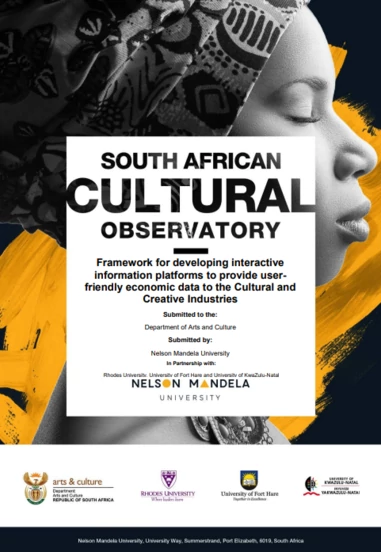
Framework for developing interactive information platforms to provide user-friendly economic data to the Cultural and Creative Industries
6.41 MB | .PDF | July 2025
Download Now
Appendix A- Appendix- SIC of all Economic Activities (Fifth Edition)
0.09 MB | .PDF | July 2025
Download Now
Appendix B- Harmonised Commodity Coding and Description System
0.14 MB | .PDF | July 2025
Download Now
Appendix C- ITC’s Creative Industries
0.31 MB | .PDF | July 2025
Download Now
Appendix D- The IP Industries and Associated Sectors
0.15 MB | .PDF | July 2025
Download Now
Appendix E- Domains by SIC (AFS)
0.14 MB | .PDF | July 2025
Download Now
Appendix F- Definition and Scope of CCIs
0.27 MB | .PDF | July 2025
Download Now
Appendix G- UNCTAD’s Classifications
0.18 MB | .PDF | July 2025
Download Now
Appendix H- Cultural Indicators
0.27 MB | .PDF | July 2025
Download Now
Appendix I- Potential Data for a Cultural Framework
0.46 MB | .PDF | July 2025
Download Now
Appendix J- Regional or City CCIs
0.19 MB | .PDF | July 2025
Download Now
Appendix K- UNCTAD’s Classification of CCI Products According to HS Codes
0.32 MB | .PDF | July 2025
Download Now
Appendix L- CCI Domains Mapped to HS Codes
0.13 MB | .PDF | July 2025
Download Now
Appendix M- Factors Included Under Technology
0.08 MB | .PDF | July 2025
Download Now
Appendix N- Cultural Indicators
0.18 MB | .PDF | July 2025
Download Now
Appendix O- Gender dimension
0.08 MB | .PDF | July 2025
Download Now

Join Our Mailing List